

Buy Latest Jun 21, 2026 300-620 Exam Q&A PDF - One Year Free Update
Download the Latest 300-620 Dump - 2026 300-620 Exam Questions
NEW QUESTION # 44
When configuring Cisco ACI VMM domain integration with VMware vCenter, which object is created in vCenter?
- A. VMware vSphere Standard vSwitch
- B. VMware vSphere Distributed Switch
- C. cluster
- D. datacenter
Answer: B
Explanation:
Section: Integrations
NEW QUESTION # 45
A Cisco ACI fabric must detect all silent endpoints for the Layer 3 bridge domain. Which actions accomplish this goal?
- A. Enable Unicast Routing.
Enable ARP Flooding. - B. Disable Unicast Routing.
Enable L2 Unknown Unicast Flood. - C. Enable Unicast Routing.
Disable ARP Flooding. - D. Disable Unicast Routing.
Enable L2 Unknown Unicast Hardware Proxy.
Answer: C
Explanation:
A silent host in Cisco ACI is an endpoint that does not actively send traffic (like ARP requests) but still needs to be detected by the fabric. Cisco ACI can detect silent endpoints using data plane learning when routing is enabled.
- Enable Unicast Routing:
This allows ACI to learn endpoints through Layer 3 mechanisms such as ARP Gleaning and routing lookups.
If Unicast Routing is enabled, the fabric can track and detect silent hosts based on ARP requests and replies.
- Disable ARP Flooding:
Disabling ARP flooding ensures that ARP requests are handled in a more controlled way using the ARP Gleaning mechanism rather than being flooded across the fabric.
This allows ACI to learn about silent hosts without requiring them to send out ARP requests.
NEW QUESTION # 46
An engineer created a monitoring policy called Test in a Cisco ACI fabric and had to change the severity level of the monitored object Call home source. Which set of actions prevent the event from appearing in event reports?
- A. Select Faults Severity Assignment Policies.
Set severity level to cleared. - B. Select Faults Severity Assignment Policies.
Set severity level to squelched. - C. Select Event Severity Assignment Policies.
Set severity level to squelched. - D. Select Event Severity Assignment Policies.
Set severity level to cleared.
Answer: B
NEW QUESTION # 47
An engineer must connect Cisco ACI fabric using Layer 2 with external third-party switches. The third-party switches are configured using 802.1s protocol. Which two constructs are required to complete the task?
(Choose two.)
- A. MCP instance policy with administrative slate disabled
- B. static binding of native VLAN in all existing EPGs
- C. spanning tree policy for mapping MST Instances to VLANs
- D. MCP policy with PDU per VLAN enabled
- E. dedicated EPG for native VLAN
Answer: B,C
Explanation:
To connect Cisco ACI fabric using Layer 2 with external third-party switches configured using 802.1s protocol, the two constructs required are:
Spanning tree policy for mapping MST Instances to VLANs (Option A): This policy will ensure that the Multiple Spanning Tree (MST) instances on the third-party switches are correctly mapped to the VLANs in the ACI fabric.
Static binding of native VLAN in all existing EPGs (Option E): This construct is necessary to maintain the native VLAN across all EPGs when integrating with third-party switches that use 802.1s protocol.
https://www.ciscolive.com/c/dam/r/ciscolive/emea/docs/2019/pdf/BRKACI-3101.pdf
https://www.cisco.com/c/en/us/solutions/collateral/data-center-virtualization/application-centric-infrastructure/white-paper-c07-732033.html
NEW QUESTION # 48
A customer creates Layer 3 connectivity to the outside network. However, only border leaf switches start receiving destination updates to other networks from the newly created L3Out. The updates must also be propagated to other Cisco ACI leaf switches. The L3Out is linked with the EPGs via a contract. Which action must be taken in the pod policy group to accomplish this goal?
- A. Implement an access management policy.
- B. Configure an IS-IS policy.
- C. Enable a COOP policy.
- D. Apply a BGP route reflector policy.
Answer: D
Explanation:
To ensure that destination updates from a newly created L3Out are propagated to all Cisco ACI leaf switches, a BGP route reflector policy should be applied. This policy allows the border leaf switches, which act as BGP route reflectors, to redistribute the learned routes to other leaf switches within the fabric1.
NEW QUESTION # 49
What do Pods use to allow Pod-to-Pod communication in a Cisco ACI Multi-Pod environment?
- A. over Layer 3 IPN connectivity via border leafs
- B. over Layer 3 Out connectivity via border leafs
- C. over Layer 3 directly connected back-to-back spines
- D. over Layer 3 IPN connectivity via spines
Answer: D
Explanation:
In a Cisco ACI Multi-Pod environment, Pods use over Layer 3 IPN connectivity via spines to allow Pod-to-Pod communication6.
https://www.cisco.com/c/en/us/solutions/collateral/data-center-virtualization/application-centric-infrastructure/white-paper-c11-737855.html
NEW QUESTION # 50
Refer to the exhibit. An engineer must configure a bridge domain inside the Cisco ACI fabric called BD. The configuration must permit EP2 and EP3 to reach EP1. Which configuration must be applied on the bridge domain to accomplish this goal?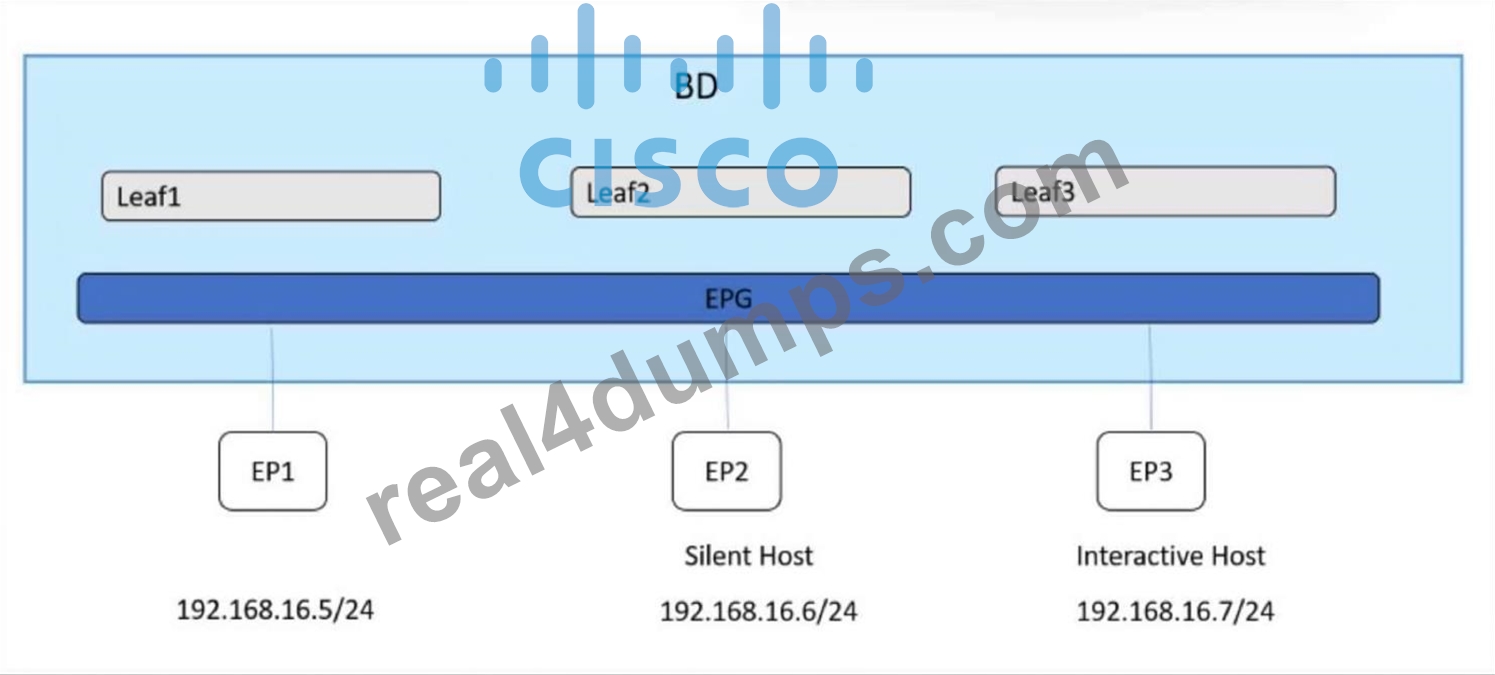
- A. Enable L2 Unknown unicast flooding.
- B. Configure unicast routing within BD.
- C. Optimize L2 Unknown unicast traffic.
- D. Define the Pervasive gateway on BD.
Answer: A
Explanation:
While enabling L2 Unknown Unicast flooding ensures that traffic is flooded to all ports when the destination MAC address is unknown, this does not directly achieve unicast routing between EPs.
Unicast routing is more efficient for known unicast traffic.
NEW QUESTION # 51
Which action sets Layer 2 loop migration in an ACI Fabric with a Layer 2 Out configured?
- A. Enable STP on the ACI fabric.
- B. Enable MCP on the ACI fabric.
- C. Disable STP on the ACI fabric.
- D. Disable STP in the external network.
Answer: B
Explanation:
Section: External Network Connectivity
NEW QUESTION # 52
Refer to the exhibit.
An engineer must configure an L3Out peering with the backbone network. The L3Out must forward unicast and multicast traffic over the link. Which two methods should be used to configure L3Out to meet these requirements? (Choose two.)
- A. port channel with SVI
- B. Layer 3 floating SVI
- C. Layer 3 routed subinterface
- D. VPC with SVI
- E. Layer 3 routed port
Answer: C,E
Explanation:
https://www.cisco.com/c/en/us/solutions/collateral/data-center-virtualization/application-centricinfrastructure/ guide-c07-743150.html#_L3Out_sStatic_rRoutes
https://www.cisco.com/c/en/us/td/docs/switches/datacenter/aci/apic/sw/4-x/L3-configuration/Cisco-APIC-Layer-3-Networking-Configuration-Guide-401/Cisco-APIC-Layer-3-Networking-Configuration-Guide-401_chapter_010010.html
NEW QUESTION # 53
What must be enabled in the bridge domain to have the endpoint table learn the IP addresses of endpoints?
- A. unicast routing
- B. subnet scope
- C. L2 unknown unicast: flood
- D. GARP based detection
Answer: A
NEW QUESTION # 54
Refer to the exhibit.
Which two objects are created as a result of the configuration? (Choose two.)
- A. attachable AEP
- B. VRF
- C. application profile
- D. endpoint group
- E. bridge domain
Answer: B,E
Explanation:
Reference:
https://www.cisco.com/c/en/us/td/docs/switches/datacenter/aci/apic/sw/2-x/rest_cfg/2_1_x/ b_Cisco_APIC_REST_API_Configuration_Guide/ b_Cisco_APIC_REST_API_Configuration_Guide_chapter_01110.html
NEW QUESTION # 55
An engineer is configuring ACI VMM domain integration with Cisco UCS-B Series.
Which type of port channel policy must be configured in the vSwitch policy?
- A. MAC Pinning
- B. LACP Active
- C. LACP Passive
- D. MAC Pinning-Physical-NIC-load
Answer: A
Explanation:
Configure the vSwitch Policies on APIC for UCS B
... ... ...
Along with this, the only supported load balancing mechanism when UCS B series is used is Route Based on Originating Virtual Port.
If you configure a mac-pinning policy, it programs the port groups to use this mechanism. This is very important in order to prevent packet loss.
Reference:
https://www.cisco.com/c/en/us/support/docs/cloud-systems-management/application-policy- infrastructure-controller-apic/118965-config-vmm-aci-ucs-00.html
NEW QUESTION # 56
Refer to the exhibit. A Cisco ACI fabric uses L3Out to connect with R1. The 192.168.1.0/24 subnet is received over the physical interface Eth1/1 of Leaf1 and Leaf2. Which set of actions must be taken to receive the 2001:db8::2:1 subnet over the interface Eth1/1 interface?
- A. Create a new interface profile.
Mark the IPv6 subnet as the export route control subnet. - B. Use the current interface profile.
Mark the IPv6 subnet as the export route control subnet. - C. Create a new interface profile.
Mark the IPv6 subnet as the import route control subnet. - D. Use the current interface profile.
Mark the IPv6 subnet as the import route control subnet.
Answer: C
Explanation:
https://www.cisco.com/c/en/us/solutions/collateral/data-center-virtualization/application-centric- infrastructure/guide-c07-743150.html#NodeandInterfaceProfilesDesign
NEW QUESTION # 57
What controls communication between EPGs?
- A. Inter-EPG communication is controlled by BGP.
- B. Inter-EPG communication is controlled by VXLAN.
- C. Inter-EPG communication is controlled by IS-IS.
- D. Inter-EPG communication is controlled by contracts.
Answer: D
Explanation:
In Cisco ACI, communication between Endpoint Groups (EPGs) is controlled by contracts. Contracts define the types of traffic and the rules that govern how EPGs can communicate with each other. They act as a policy framework that enforces security and segmentation within the ACI fabric.
NEW QUESTION # 58
An engineer must allow multiple external networks to communicate with internal ACI subnets. Which action should the engineer take to assign the prefix to the class ID of the external Endpoint Group?
- A. Enable the Export Route Control Subnet for the External Endpoint Group flag.
- B. Configure subnets with the External Subnets for External EPG flag enabled.
- C. Enable an L30ut with Shared Route Control Subnet.
- D. Configure subnets with the Import Route Control Subnet flag enabled.
Answer: B
Explanation:
To allow multiple external networks to communicate with internal ACI subnets and assign the prefix to the class ID of the external Endpoint Group, the engineer should configure subnets with the External Subnets for External EPG flag enabled1. This configuration allows the specified subnets to be associated with an external EPG, which facilitates communication between internal tenants and external routed networks via L3Outs1.
https://www.cisco.com/c/en/us/td/docs/switches/datacenter/aci/apic/sw/1-x/ACI_Best_Practices/b_ACI_Best_Practices/b_ACI_Best_Practices_chapter_01001.html
NEW QUESTION # 59
Refer to the exhibit.
Refer to the exhibit. A client is configuring a new Cisco ACI fabric. All VLANs will be extended during the migration phase using the VPC connections on leaf switches 3. 4 and leaf switches toward the legacy network. The migration phase has these requirements;
* If The legacy switches must be able to transfer BPDUs through the ACI fabric.
* If the legacy switches fail to break a loop. Cisco ACI must break the loop.
Which group settings must be configured on VPC interface policy groups ipg_vpc-legacy_1 and ipg_vpc-legacy_2 to meet these requirements?
- A. MCP: enabled
BPDU Guard: disabled
BPDU Filter: disabled - B. MCP: disabled
BPDU Guard: disabled
BPDU Filter: enabled - C. MCP: enabled
BPDU Guard: enabled
BPDU Filter: disabled - D. MCP: disabled
BPDU Guard: enabled
BPDU Filter enable
Answer: A
NEW QUESTION # 60
An engineer needs to deploy a leaf access port policy group in ACI Fabric to support the following requirements:
* Control the amount of application data flowing into the system
* Allow the newly connected device to auto-negotiate link speed with the leaf switch Which two ACI policies must be configured to achieve these requirements? (Choose two.)
- A. slow drain policy
- B. ingress control plane policing policy
- C. L2 interface policy
- D. ingress data plane policing policy
- E. link level policy
Answer: D,E
Explanation:
Explanation
Slow Drain handles FCoE packets that are causing traffic congestion on ACI fabric. So, it is wrong.
Ingress control plane is wrong, because the request is for "application data flowing".
L2 interface policy is concerned about QinQ and VLAN scope.
NEW QUESTION # 61
An engineer configures port-12 on Leaf-101 and Leaf-102 to connect to a new server, SVR-12. The new server will belong to EPG-12 and use encap VLAN-1212. The engineer configured SVR-12 as a VPC member port and statically bound the VPC member port to EPG-12. Which additional step must the engineer take to configure connectivity?
- A. Configure an LACP Interface Policy and apply it to EPG-12.
- B. Create a VPC Explicit Protection Group for EPG-12 and VLAN-1212.
- C. Associate a domain with EPG-12 that is associated with VLAN-1212.
- D. Select VLAN-1212 on the EPG-12 Interface Policy Group.
Answer: C
Explanation:
The engineer configures port 1/2 on Leaf-101 and Leaf-102 to connect to a new server (SVR-12), which belongs to EPG-12 using VLAN-1212 encapsulation. The server is configured as a vPC member port and statically bound to EPG-12. The task is to ensure connectivity, indicating a missing configuration step.
Requirement Analysis
Static binding of a vPC member port to an EPG requires proper VLAN association and domain mapping.
vPC ensures redundancy, and the VLAN (1212) must be allocated and associated with the EPG via a domain (e.g., VMM or physical domain).
Option Evaluation
A . Create a VPC Explicit Protection Group for EPG-12 and VLAN-1212:
vPC Explicit Protection Groups are used for specific vPC configurations, but this is not a standard requirement for EPG binding and VLAN association.
Reference:
B . Associate a domain with EPG-12 that is associated with VLAN-1212:
Associating a domain (e.g., VMM or physical domain) with EPG-12 and mapping VLAN-1212 ensures the VLAN is allocated and recognized by the fabric for the vPC ports. This is a critical step for static binding to work.
C . Select VLAN-1212 on the EPG-12 Interface Policy Group:
The Interface Policy Group defines port settings, but VLAN selection is managed via the domain association, not the policy group alone. This is insufficient.
D . Configure an LACP Interface Policy and apply it to EPG-12:
LACP is optional for vPC and not required for static EPG binding. The issue is VLAN/domain association, not link aggregation.
Final Answer Justification
B is correct because associating a domain with EPG-12 and VLAN-1212 ensures the fabric recognizes the VLAN encapsulation and applies the EPG configuration to the vPC ports.
Primary Cisco Reference:
Cisco APIC vPC Deployment Guide.
Cisco ACI EPG and Domain Configuration Guide.
NEW QUESTION # 62
Which two statements regarding ACI Multi-Site are true? (Choose two.)
- A. The Inter-Site network routers should run OSPF to establish peering with the spines.
- B. ACI Multi-Site is a solution that supports a dedicated APIC cluster per site.
- C. ACI Multi-Site is a solution that allows one APIC cluster to manage multiple ACI sites.
- D. The Multi-Site orchestrator must be directly attached to one ACI leaf.
- E. Routers in the Inter-Site network must run OSPF, DHCP relay, and MP-BGP.
Answer: A,C
NEW QUESTION # 63
Refer to the exhibit.
Refer to the exhibit. An engineer is migrating legacy servers into the Cisco ACI environment. The requirement is to ensure that all endpoints and MAC addresses are learned properly in legacy and Cisco ACI switches. Which configuration set must be configured under the bridge domain called bd__360 to accomplish this goal?
- A. L2 Unknown Unicast: Flood
- B. L2 Unknown Unicast: Flood ARP Flooding: Disabled
- C. L2 Unknown Unicast: Hardware Proxy ARP Flooding: Disabled
- D. L2 Unknown Unicast: Hardware Proxy ARP Flooding: Enabled
Answer: A
Explanation:
ARP Flooding: Enabled
NEW QUESTION # 64
......
Verified 300-620 Dumps Q&As - 1 Year Free & Quickly Updates: https://www.real4dumps.com/300-620_examcollection.html
Latest Cisco 300-620 Certification Practice Test Questions: https://drive.google.com/open?id=1pdZ0LZBeJTMgqNu45ysDKfYmOZHRenlG
