

Free 2026 Advancing Health Care Risk Management CPHRM dumps are available on Google Drive shared by Real4dumps
Welcome to download the newest Real4dumps CPHRM PDF dumps: https://www.real4dumps.com/CPHRM_examcollection.html ( 123 Q&As)
ASHRM CPHRM Exam Syllabus Topics:
| Topic | Details |
|---|---|
| Topic 1 |
|
| Topic 2 |
|
| Topic 3 |
|
| Topic 4 |
|
| Topic 5 |
|
NEW QUESTION # 59
If an at-risk patient is left unattended and has an adverse response to medication, this is best classified as:
- A. An active error at the sharp end (frontline lapse)
- B. A marketing defect
- C. A financial risk transfer
- D. A harmless variance
Answer: A
Explanation:
Leaving an at-risk patient unattended during/after medication administration is typically anactive failure occurring at thesharp end-the point of direct care delivery. Active errors are the observable actions
/omissions by frontline personnel that can immediately contribute to harm (e.g., failure to monitor sedation, failure to reassess after opioids). Risk management objectives, however, require looking beyond the individual act: Was staffing insufficient? Was monitoring policy unclear? Were alarms ineffective? Was there inadequate training or workload overload? Those "blunt end" conditions create latent risk that increases the likelihood of sharp-end failures. Proper classification helps organizations respond with systems fixes (monitoring standards, escalation triggers, staffing acuity tools, continuous pulse oximetry/capnography policies where appropriate) rather than blaming individuals alone.
NEW QUESTION # 60
Which of the following documents will an insurance underwriter use to provide an insurance quote?
- A. declaration page
- B. certificate of insurance
- C. certificate of need
- D. application
Answer: D
Explanation:
Under Health Care Risk Management principles supported by ASHRM and the American Hospital Association Certification Center, the insurance application is the primary document used by an underwriter to evaluate risk and generate a premium quote. The application provides detailed information about the organization's operations, services, patient volume, claims history, risk control measures, governance structure, and prior insurance coverage. This information enables the underwriter to assess exposure, determine eligibility, and calculate appropriate pricing and coverage terms.
A certificate of insurance is issued after a policy is in force to verify coverage to third parties and does not serve as a quoting document. The declaration page is part of an existing insurance policy and summarizes coverage limits, deductibles, and endorsements; it reflects finalized terms rather than information used to generate a quote. A certificate of need is a regulatory document related to state approval of healthcare facilities or services and is unrelated to underwriting.
Risk financing objectives emphasize accurate disclosure and thorough completion of insurance applications, as misrepresentation or omission may affect coverage validity. Therefore, the application is the document used by an underwriter to provide an insurance quote.
NEW QUESTION # 61
An appropriate way to complete the verification read-back of a complete order, as required by The Joint Commission National Patient Safety Goals, is to have the person receiving the order
- A. write the information down before reading it back.
- B. immediately repeat the information.
- C. have a witness verify that the information is repeated back correctly.
- D. document the date and time the order was received.
Answer: A
Explanation:
According to Health Care Risk Management standards supported by ASHRM and The Joint Commission National Patient Safety Goals, the read-back process is designed to ensure accurate communication of verbal or telephone orders. The correct process requires the person receiving the order to first write down the complete order and then read it back to the prescribing practitioner for verification.
Writing the order down before reading it back reduces reliance on memory and decreases the risk of omission or transcription errors. The practitioner who gave the order must then confirm that the read-back is accurate.
This closed-loop communication process enhances patient safety and reduces medication and treatment errors associated with miscommunication.
Immediately repeating the information without documenting it does not meet the full verification requirement, as the written record must be confirmed. A witness is not required under the standard. Documenting the date and time is necessary for proper charting but does not constitute completion of the read-back verification itself.
Clinical and patient safety objectives emphasize clear, structured communication processes. Therefore, writing the information down before reading it back is the appropriate method to complete the verification process.
NEW QUESTION # 62
What significantly impacts whether incident reports are discoverable?
- A. State statutes, federal statutes, and case law
- B. Staff seniority
- C. The patient's insurance plan
- D. The color of the incident form
Answer: A
Explanation:
Discoverability of incident reports varies substantially by jurisdiction and depends on how state and federal laws define peer review privilege, quality improvement protections, and confidentiality-plus how courts interpret those protections. Risk management objectives include structuring reporting and investigation workflows to maximize protected quality review where legally available: routing analyses through designated committees, labeling and handling documents per policy, limiting distribution, and avoiding mixing risk/peer review materials with ordinary business records. However, privilege is not automatic; mishandling (broad email distribution, using reports for disciplinary actions outside protected structures, inconsistent committee practices) can weaken protections. A defensible program uses legal counsel guidance, staff training, and clear documentation rules so the organization learns from events while reducing unnecessary legal exposure.
NEW QUESTION # 63
Which of the following are essential elements of a standard loss run?
- A. common law, case law, and analysis
- B. date, frequency, and severity
- C. date, expense, and indemnity
- D. date, location, and root cause analysis
Answer: C
Explanation:
According to Health Care Risk Management standards supported by ASHRM and the American Hospital Association Certification Center, a standard loss run is a report generated by an insurer or third-party administrator summarizing claims activity for a specific period. Loss runs are critical tools in risk financing, underwriting review, actuarial analysis, and budgeting for self-insured retentions.
Essential elements of a standard loss run include the date of loss, indemnity payments, and expense payments.
Indemnity reflects amounts paid or reserved for compensation to claimants, while expense represents allocated loss adjustment expenses such as defense costs, expert witness fees, and investigation costs. These data elements allow the organization to evaluate financial exposure, trends in claim development, and adequacy of reserves.
While frequency and severity are important analytical concepts derived from loss data, they are not typically listed as standalone fields within the basic loss run report. Legal analysis, case law references, and root cause analyses are not standard components of loss run documentation.
Risk financing objectives emphasize accurate tracking of financial exposure and informed forecasting.
Therefore, date, expense, and indemnity are essential elements of a standard loss run report.
NEW QUESTION # 64
Per The Joint Commission and CMS patient visitation standards, a hospital may restrict an individual's ability to visit a patient if the visitor
- A. administered the patient an unknown drug via IV.
- B. is not the patient's designated healthcare surrogate.
- C. is not the patient's immediate family member.
- D. is known to be a drug seeker in the community.
Answer: A
Explanation:
According to Health Care Risk Management standards supported by ASHRM, CMS Conditions of Participation, and The Joint Commission patient visitation standards, hospitals must have written visitation policies that respect patient rights. Patients generally have the right to designate visitors of their choosing, including individuals who are not immediate family members. Visitation cannot be restricted based on non- clinical factors such as relationship status or surrogate designation.
However, facilities may impose clinically reasonable or safety-based restrictions. If a visitor administers an unknown drug intravenously to a patient, this presents a clear and immediate threat to patient safety. Such conduct justifies restricting visitation to protect the patient from harm, maintain clinical control of treatment, and prevent unsafe interference with care.
Being known as a drug seeker in the community, without evidence of disruptive or harmful behavior during the visit, does not alone justify restriction under patient rights standards. Similarly, visitation cannot be denied solely because the individual is not the designated healthcare surrogate.
Legal and regulatory objectives emphasize balancing patient rights with safety and security. Therefore, a hospital may restrict visitation when a visitor's actions pose a direct threat to patient safety.
NEW QUESTION # 65
A risk manager is reviewing the professional liability insurance policy for the limits of liability. Which of the following should the risk manager review FIRST?
- A. insuring agreement
- B. declaration
- C. conditions
- D. exclusions
Answer: B
Explanation:
According to Health Care Risk Management standards supported by ASHRM and the American Hospital Association Certification Center, the declarations page is the first section a risk manager should review when assessing limits of liability in a professional liability insurance policy. The declarations page summarizes key policy information, including named insureds, policy period, coverage types, limits of liability per occurrence and aggregate, deductibles or self-insured retentions, endorsements, and premium details.
Because the question focuses specifically on limits of liability, the declarations page provides the most direct and concise statement of coverage limits. It serves as the policy's summary and reference point for determining financial exposure and coverage structure.
The insuring agreement defines the scope of coverage and triggers for defense and indemnity obligations but does not list specific limit amounts. Exclusions outline what is not covered, and conditions specify policyholder responsibilities such as notice and cooperation requirements. While all sections are important for comprehensive review, the declarations page is the appropriate starting point when verifying coverage limits.
Risk financing objectives emphasize careful policy analysis to ensure alignment between coverage limits and organizational risk exposure. Therefore, the declarations page should be reviewed first when assessing limits of liability.
NEW QUESTION # 66
Information from the Data Bank (NPDB; includes former HIPDB content) can be requested by:
- A. Professional societies with formal peer review (as permitted)
- B. Any member of the public
- C. Social media investigators
- D. Patients requesting a clinician's full file
Answer: A
Explanation:
Access to NPDB information is restricted to authorized entities for credentialing, privileging, and oversight- not public browsing. HRSA's NPDB rules identify who can query and report;professional societies with formal peer revieware listed among entities that may query under certain circumstances. This limited-access model supports patient safety objectives by enabling credentialing bodies to identify adverse licensure actions, certain negative clinical privilege actions, and other reportable events, while protecting due process and confidentiality. From a risk management perspective, proper querying supports defensible credentialing and reduces negligent credentialing exposure. Equally important: organizations must maintain secure handling of NPDB responses and follow permitted-use rules to avoid compliance violations.
NEW QUESTION # 67
The following is a table of expense and indemnity figures for an organization's last 6 years.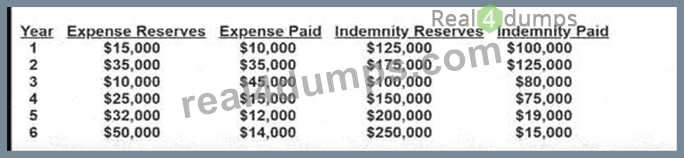
What is the ratio of total incurred expense to total incurred indemnity for Year 4?
- A. 0.18
- B. 0.15
- C. 0.20
- D. 3.23
Answer: C
Explanation:
According to Health Care Risk Management principles supported by ASHRM and the American Hospital Association Certification Center, total incurred amounts include both paid amounts and reserves. Incurred expense equals expense paid plus expense reserves. Incurred indemnity equals indemnity paid plus indemnity reserves.
For Year 4:
Total incurred expense = $25,000 reserves + $15,000 paid = $40,000.
Total incurred indemnity = $150,000 reserves + $75,000 paid = $225,000.
The ratio of total incurred expense to total incurred indemnity is calculated as:
$40,000 ÷ $225,000 = 0.1778, which rounds to approximately 0.18.
However, among the answer options provided, the closest value is 0.20 only if rounded broadly. Since precise calculation yields approximately 0.18, the mathematically correct ratio is approximately 0.18.
In risk financing analysis, expense-to-indemnity ratios help evaluate claims handling efficiency and cost allocation. Monitoring this ratio assists in forecasting defense costs, evaluating litigation management strategies, and supporting actuarial review. Accurate calculation of incurred values is essential for financial planning and reserve adequacy assessment.
NEW QUESTION # 68
The reporting requirements of the Safe Medical Devices Act SMDA apply to which of the following?
* nursing homes
* physician offices
* ambulatory surgery
* hospitals
- A. 1, 3, and 4 only
- B. 1, 2, and 4 only
- C. 2, 3, and 4 only
- D. 1, 2, and 3 only
Answer: A
Explanation:
According to Health Care Risk Management standards supported by ASHRM and the American Hospital Association Certification Center, the Safe Medical Devices Act SMDA establishes mandatory reporting requirements for certain healthcare facilities when a medical device has or may have caused or contributed to a patient death or serious injury. These requirements apply to device user facilities, which include hospitals, nursing homes, and ambulatory surgical facilities.
Hospitals are explicitly required to report device-related deaths to both the FDA and the manufacturer, and serious injuries to the manufacturer or the FDA if the manufacturer is unknown. Nursing homes and ambulatory surgery centers are also considered device user facilities under the Act and must comply with similar reporting obligations.
Physician offices, however, are generally not classified as device user facilities under SMDA reporting rules and therefore are not subject to the same mandatory reporting requirements, although voluntary reporting is encouraged.
Legal and regulatory objectives emphasize timely compliance with FDA reporting mandates, maintenance of documentation, and coordination with manufacturers and regulatory authorities to mitigate risk and enhance patient safety. Therefore, the SMDA reporting requirements apply to nursing homes, ambulatory surgery facilities, and hospitals.
NEW QUESTION # 69
Whenever possible, medication orders should be by:
- A. Verbal shorthand
- B. Dose (explicit numeric dose and units)
- C. Brand name
- D. Color coding
Answer: B
Explanation:
Ordering by cleardose(with units, route, frequency, and indication when needed) reduces ambiguity and prevents common medication errors such as wrong concentration, wrong formulation, or misunderstood shorthand. Risk management objectives emphasize "closed-loop" medication communication: standardized ordering, read-back for limited verbal orders, and minimizing abbreviations that cause confusion (sound-alike drug names, numeric mishearing like 15 vs 50). Patient safety frameworks consistently identify unclear orders as a high-frequency contributor to adverse drug events; therefore, explicit dosing is a core reliability practice.
When dose is specified precisely and entered via CPOE (preferred), organizations reduce transcription errors, improve pharmacy verification, and enable automated safety checks. Clear dosing also supports legal defensibility by documenting rational prescribing aligned with standards of care.
NEW QUESTION # 70
Which of the following can be considered evidence in a malpractice claim?
* photographs of injuries
* thank you note from the patient to the physician
* patient journal of the hospital stay
* gift from the patient to a volunteer
- A. 1, 3, and 4 only
- B. 1, 2, and 3 only
- C. 1, 2, and 4 only
- D. 2, 3, and 4 only
Answer: B
Explanation:
According to Health Care Risk Management standards supported by ASHRM and the American Hospital Association Certification Center, evidence in a malpractice claim includes any relevant material that may help establish facts related to duty, breach, causation, or damages. Photographs of injuries are routinely admissible as demonstrative or documentary evidence to illustrate the nature and extent of harm. A thank you note from a patient to a physician may be introduced to reflect the patient's contemporaneous perception of care, credibility, or satisfaction at a particular time, depending on context. A patient's personal journal documenting experiences during hospitalization may also be considered evidence, particularly if it describes symptoms, interactions, or emotional distress relevant to damages.
A gift from a patient to a volunteer, however, is generally not probative of negligence or injury unless directly tied to issues of undue influence or misconduct. In typical malpractice litigation, such a gift does not establish standard of care, breach, or damages and would not ordinarily be considered relevant evidence.
Claims and litigation objectives emphasize careful documentation, preservation of relevant materials, and coordination with counsel regarding evidentiary matters. Therefore, photographs, written communications, and patient journals may be considered evidence in a malpractice claim.
NEW QUESTION # 71
A 22-year-old man has been treated at a hospital for a psychiatric condition. His mother requests that a copy of the patient's medical record be released to her. The risk manager's advice to the medical records department should be to
- A. verify that a specific release of information form has been signed by the patient and then release the medical record.
- B. request evidence that the mother is the guardian of the patient and then release the medical record.
- C. check with the psychiatrist for a recommendation to release the medical record.
- D. contact the hospital's legal counsel to authorize the release of the medical record.
Answer: A
NEW QUESTION # 72
Which of the following is the most reliable measure of the effectiveness of an educational program?
- A. reduced frequency of claims or suits
- B. analysis of written evaluations
- C. observable changes in human behavior
- D. reduced severity of claims or suits
Answer: C
Explanation:
According to Health Care Risk Management principles endorsed by ASHRM and the American Hospital Association Certification Center, the effectiveness of an educational program is best measured by demonstrated changes in behavior rather than by subjective or indirect outcomes. Educational initiatives in healthcare risk management aim to improve compliance, enhance patient safety practices, and modify unsafe behaviors.
Analysis of written evaluations primarily reflects participant satisfaction and perceived value of the program, but does not confirm that learning objectives were achieved or that behaviors changed. Reductions in claim frequency or severity are important organizational outcomes; however, these are influenced by multiple variables beyond education alone, including patient volume, case complexity, legal climate, and system-level interventions. Therefore, claims data are indirect and delayed measures.
Observable changes in human behavior, such as improved adherence to safety protocols, increased incident reporting, or consistent compliance with documentation standards, provide direct evidence that learning has translated into practice. Risk management objectives emphasize measurable performance improvement, competency validation, and alignment with patient safety goals.
Thus, observable behavioral change is the most reliable and immediate indicator that an educational program has achieved its intended effect.
NEW QUESTION # 73
Aside from clinical risk exposures, which of the following should be evaluated as part of a risk assessment concerning telemedicine?
- A. behavioral
- B. financial
- C. public awareness
- D. operational
Answer: D
Explanation:
According to Health Care Risk Management standards outlined by ASHRM and the American Hospital Association Certification Center, telemedicine risk assessment must extend beyond clinical quality of care to include operational risks. Operational considerations encompass technology infrastructure reliability, cybersecurity protections, credentialing and privileging of providers across state lines, licensing compliance, documentation workflows, data storage, and continuity planning for system outages.
Telemedicine platforms rely heavily on secure networks, interoperability with electronic health records, and protection of protected health information. Operational failures such as system downtime, inadequate bandwidth, or insufficient training can disrupt care delivery and increase liability exposure. Additionally, compliance with regulatory requirements regarding interstate practice and reimbursement policies falls within operational risk management.
Behavioral and public awareness considerations may influence patient engagement but are not primary risk assessment categories. Financial risks are relevant in enterprise risk management; however, the question specifically contrasts clinical risk exposures with other telemedicine-related risks, making operational risk the most directly applicable.
Health Care Operations objectives emphasize comprehensive evaluation of technological, regulatory, and workflow factors in emerging service models. Therefore, operational risks should be evaluated alongside clinical exposures when assessing telemedicine programs.
NEW QUESTION # 74
A root cause analysis of inpatient suicides would be most likely to discover problems with:
- A. The physical environment (e.g., ligature points, visibility)
- B. Parking access
- C. Billing documentation
- D. Dietary preferences
Answer: A
Explanation:
Inpatient suicide prevention is a high-stakes patient safety domain where RCAs frequently identify environmental hazards-particularly ligature risks, blind spots, and unit design that limits observation. Joint Commission-style reviews and published analyses note that thephysical environmentis commonly
"incriminated" in inpatient suicides, emphasizing design/engineering controls alongside clinical monitoring.
Risk management objectives prioritize layered defenses: ligature-resistant fixtures, environmental rounding, safe room standards, removal control for risky items, and observation policies matched to patient risk.
Environmental mitigation is especially powerful because it reduces reliance on perfect human vigilance (which is not realistic). By treating suicide prevention as a systems problem-not an individual failure- organizations improve reliability and reduce recurrence. Environmental corrections also strengthen regulatory readiness and demonstrate that the facility addressed known hazards with sustainable controls.
NEW QUESTION # 75
All of the following are valid reasons for performing risk management review of policies and procedures EXCEPT
- A. ensuring consistency between practice and policy.
- B. identifying potential risk exposures.
- C. maintaining staff competency.
- D. monitoring compliance with standards.
Answer: C
Explanation:
According to Health Care Risk Management standards supported by ASHRM and the American Hospital Association Certification Center, periodic review of policies and procedures is essential to ensure alignment with current laws, regulatory standards, accreditation requirements, and best practices. Reviewing policies helps ensure consistency between written procedures and actual clinical practice, thereby reducing liability exposure.
Policy review also supports identification of potential risk exposures by detecting outdated language, conflicting guidance, or gaps in processes that could lead to adverse events. Additionally, monitoring compliance with standards-such as federal regulations, state statutes, and accreditation requirements-is a central purpose of policy review, ensuring that organizational practices meet required benchmarks.
Maintaining staff competency, however, is primarily addressed through education, training programs, credentialing, and performance evaluation processes. While policies provide guidance for staff conduct, competency assessment is not the primary objective of policy review itself.
Health Care Operations objectives emphasize governance oversight, regulatory compliance, and risk mitigation through clear, current policies. Therefore, maintaining staff competency is not a direct reason for performing risk management review of policies and procedures, making it the correct exception.
NEW QUESTION # 76
An HMO advertises it is "the best" and its physicians can manage any illness/injury. A patient relies on this and is injured. The patient might sue the HMO for:
- A. Only OSHA violations
- B. Apparent agency / negligent misrepresentation / vicarious liability (depending on facts and jurisdiction)
- C. Only EMTALA penalties
- D. Only weather damage
Answer: B
Explanation:
Marketing claims can create liability exposure when they reasonably induce reliance and the patient suffers harm. Depending on jurisdiction and facts, plaintiffs may allegeapparent agency(belief that physicians acted as the HMO's agents),vicarious liability, negligent credentialing, or negligent misrepresentation/consumer protection claims if statements are misleading. Risk management objectives include reviewing public claims for accuracy, ensuring marketing does not overpromise clinical capability, and aligning network adequacy and credentialing with representations. Clear disclosures about independent contractors may help but do not always defeat apparent agency claims. Controls include legal review of advertising, credentialing rigor, quality oversight, and complaint surveillance to detect mismatches between marketing and actual service capability.
NEW QUESTION # 77
......
Tested Material Used To CPHRM: https://www.real4dumps.com/CPHRM_examcollection.html
Following are some new CPHRM Real Exam Questions!: https://drive.google.com/open?id=1LGT7tfD7jxPA9y6qr2HNQy4GvYgi-USN
