

ISTQB-CTAL-TA Exam Questions Dumps, Selling ISTQB Products
ISTQB-CTAL-TA Cert Guide PDF 100% Cover Real Exam Questions
ISTQB CTAL-TA certification exam is designed for experienced software testers who want to enhance their skills in test analysis and design. (ISTQB CTAL-TA) ISTQB Certified Tester Advanced Level - Test Analyst (Syllabus 2012) certification is part of the ISTQB Advanced Level certification program, which has three modules: Test Manager, Test Analyst, and Technical Test Analyst. The Test Analyst module is focused on equipping testers with the knowledge and skills to perform effective test analysis and design, as well as to implement and execute tests using various techniques and tools.
ISTQB CTAL-TA certification exam is recognized globally and is highly valued in the software testing industry. It is a testament to the candidate's advanced-level knowledge and skills in test analysis and is often sought after by employers looking to hire skilled and experienced software testers. By passing the ISTQB CTAL-TA certification exam, candidates can demonstrate their proficiency in test analysis and gain a competitive edge in the job market.
NEW QUESTION # 39
Rather than developing an e-commerce product, management has decided to acquire a COTS package The e- commerce product needs to interface.
with backend applications such a finance, stock control and order delivery. You are asked to define a test plan for this project.
Given just the information in the scenario, which of the following software quality characteristics must be included in your test plan?
- A. Maintainability
- B. Reliability
- C. Interoperability
- D. Portability
Answer: C
Explanation:
The software quality characteristic that must be included in the test plan for this project is interoperability.
Interoperability is a software quality characteristic that evaluates the degree to which two or more systems or components can exchange information and use the information that has been exchanged. This characteristic is relevant for a project that involves acquiring a COTS package that needs to interface with backend applications such as finance, stock control, and order delivery. Verified References: [ISTQB Certified Tester Advanced Level Test Analyst CTAL-TA], Section 5.3.1, page 67.
NEW QUESTION # 40
Which pair of statements correctly describes when functional completeness, functional correctness, and
/or functional appropriateness are undertaken?
SELECT ONE OPTION
- A. Functional appropriateness testing is usually undertaken during system testing (but also during the later stages of integration testing); functional correctness testing can be conducted at any test level
- B. Functional completeness is performed as the last stage of testing; Functional correctness can be undertaken at any test level and often uses the specification or legacy system as a test oracle
- C. Functional correctness testing is only performed at the system test level; functional completeness is performed at the system integration testing stage
- D. Functional completeness for system integration may focus on high-level business cases; functional appropriateness is usually performed prior to system testing
Answer: A
Explanation:
Comprehensive and Detailed in Depth Explanation:
* Functional appropriateness testingis often done duringsystem testingbecause it evaluates whether the implemented functions meet user needs, but it can also be part ofintegration testingwhen assessing integrated components.
* Functional correctness testingisnot limited to any specific test level. It can be performed duringunit, integration, system, or acceptance testingto verify the accuracy of functions.
* Option Bis incorrect because functional completeness is not necessarily the last stage of testing.
* Option Cis incorrect because functional appropriateness is mainly done during system testing, not before.
* Option Dis incorrect because functional correctness is not restricted to system testing.
The correct answer isA (Functional appropriateness testing is usually undertaken during system testing; functional correctness testing can be conducted at any test level).
NEW QUESTION # 41
A PIN entry component of an ATM system has been developed using the following state table: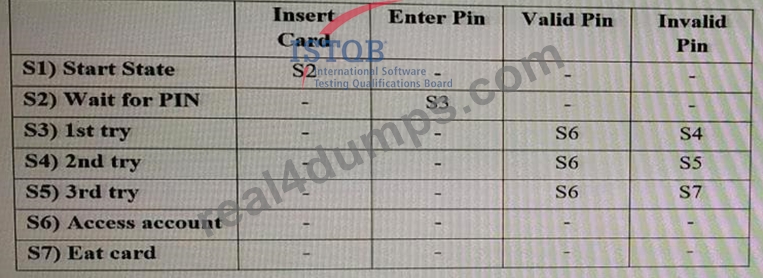
Using the state transition test technique, how many 0-switch test cases are needed to achieve 100% 0-switch coverage?
- A. 0
- B. 1
- C. 2
- D. 3
Answer: A
Explanation:
Eight 0-switch test cases are needed to achieve 100% 0-switch coverage. A state transition test technique is a technique that tests the behavior of a system or component based on its states and transitions between them. A
0-switch test case is a test case that covers one state and its associated actions and events. To achieve 100% 0- switch coverage, all states and their associated actions and events must be covered by at least one test case.
The states for this scenario are:
* Enter PIN
* PIN OK
* PIN not OK
* 1st try
* 2nd try
* 3rd try
* Access to act
* Eat card
Verified References: [ISTQB Certified Tester Advanced Level Test Analyst CTAL-TA], Section 3.4.1, page 39.
NEW QUESTION # 42
Based on the tax system specification as described below, using boundary value analysis, which would be the best test set to explicitly test on single boundary value fully?
Tax system
A tax system needs to be updated due to new legislation. For a person with a salary of less than € 20 000 and who is married, the tax needs to be recalculated.
If a person has at least three and less than six children, an additional 10% reduction is applicable.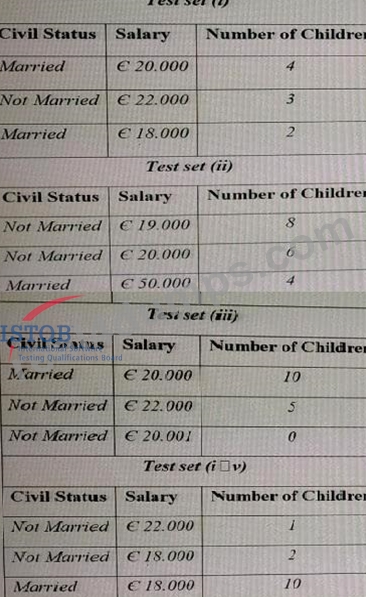
- A. Test set (i)
- B. Test set (ii)
- C. Test set (iii)
- D. Test set (iv)
Answer: B
Explanation:
The test set B is the best test set to explicitly test on single boundary value fully, using boundary value analysis. Boundary value analysis is a technique that tests the values at or near the boundaries of an input domain. The boundaries for this scenario are:
* Salary less than €20 000
* Number of children at least three and less than six
The test set B tests the boundary values of each boundary (€19 999, €20 000, three children, six children) and one value inside each boundary (€19 998, €20 001, four children). Verified References: [ISTQB Certified Tester Advanced Level Test Analyst CTAL-TA], Section 3.2.2, page 35.
NEW QUESTION # 43
You are testing a hospital patient management system. New or amended patient data is captured by hospital administrators using an in-house patient capture application and transmitted to one or more hospital departments depending on the nature of the medical condition. Each department operates its own software package.
There has been a change to the patient capture application, and you are going to run a series of interoperability tests.
Which TWO of the following are NOT interoperability defects?
a) The patient name field is truncated on one of the receiving department systems b) Hospital administrators find the new patient-capture application screens difficult to navigate c) Two department systems are unable to recognize the format of international telephone numbers for foreign patients d) Existing patient data takes too long to retrieve by the patient-capture application e) There are spelling errors in the field names on some screens SELECT ONE OPTION:
- A. b, d
- B. a, b
- C. a, c
Answer: A
Explanation:
Comprehensive and Detailed In-Depth Explanation:
* a)Truncated data is an interoperability issue related to data exchange between systems.
* b)User navigation issues are related tousability, not interoperability.
* c)Format mismatch between systems is an interoperability defect.
* d)Slow data retrieval is related toperformance, not interoperability.
* e)Spelling errors relate tousability, not interoperability.
Therefore, the correct answer isA (b, d).
NEW QUESTION # 44
You are a Test Analyst in the banking domain. You have received the following requirement: "The system shall allow cash advances of at least 200 Euros for all supported credit cards. The following credit cards are supported: American Express, Diners, Visa, Mastercard and Eurocard.
Which one of the findings described below is true regarding this requirement?
- A. The requirement indicates potential performance problems.
- B. The requirement is unclear in terms of advance limits.
- C. The requirement is ambiguous in terms of supported cards.
- D. The requirement indicates potential usability problems
Answer: B
Explanation:
The finding that is true regarding this requirement is that it is unclear in terms of advance limits. The requirement states that the system shall allow cash advances of at least 200 Euros, but it does not specify what is the maximum amount or if there are any other restrictions or conditions for the cash advances. This makes the requirement ambiguous and incomplete, as it does not provide enough information for testing or implementation. Verified References: [ISTQB Certified Tester Advanced Level Test Analyst CTAL-TA], Section 2.3.1, page 23.
NEW QUESTION # 45
Which statement BEST describes the activities performed by the Test Analyst during the TEST ANALYSIS stage of the test process?
SELECT ONE OPTION
- A. Ensuring that multiple product risks are covered by one test condition to reduce maintenance overheads
- B. Defining the start and completion dates for the test analysis stage
- C. Applying test techniques to reduce the likelihood of omitting important test conditions
- D. Producing high-level test cases and defining the supporting test data
Answer: C
Explanation:
Comprehensive and Detailed in Depth Explanation:
According to the ISTQB CTAL-TTA syllabus, theTest Analysisstage involves identifying test conditions based on test basis documentation, requirements, and risk analysis. The primary focus is on analyzing the test basis to identify what needs to be tested. Applying test techniques during this stage helps reduce the risk of missing important test conditions. Therefore, Option A correctly states that test techniques are applied to minimize the risk of omitting important conditions.
Option B is incorrect because combining multiple product risks into one test condition can lead to overlooking specific risks, which contradicts the goal of thorough test analysis.
Option C is incorrect as defining dates is part of planning, not analysis.
Option D is incorrect because producing high-level test cases and defining data are tasks related to test design, which follows test analysis.
This detailed breakdown aligns with the ISTQB syllabus, emphasizing that test analysis primarily deals with identifying test conditions through the application of test techniques.
NEW QUESTION # 46
A PIN entry component of an ATM system has been developed using the following state table: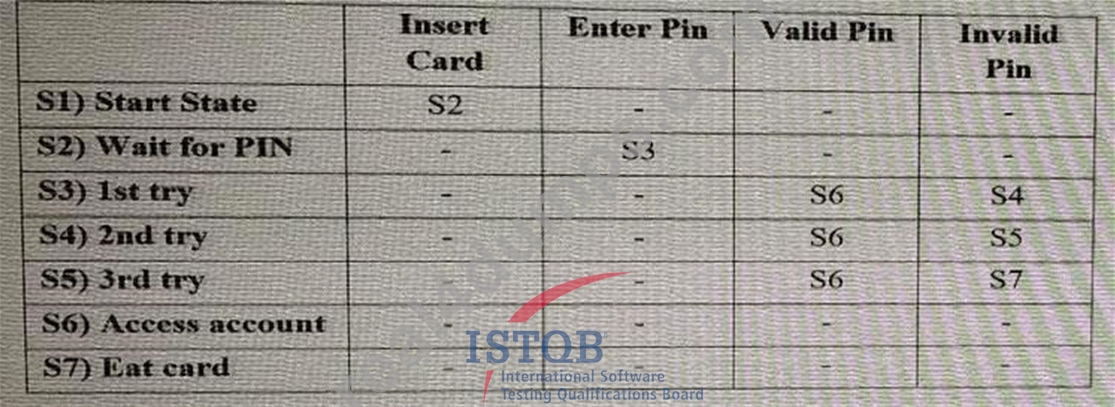
Using the state transition test technique, how many 0-switch test cases are needed to achieve 100% 0-switch coverage?
- A. 0
- B. 1
- C. 2
- D. 3
Answer: A
Explanation:
Eight 0-switch test cases are needed to achieve 100% 0-switch coverage. A state transition test technique is a technique that tests the behavior of a system or component based on its states and transitions between them. A
0-switch test case is a test case that covers one state and its associated actions and events. To achieve 100% 0- switch coverage, all states and their associated actions and events must be covered by at least one test case.
The states for this scenario are:
* Enter PIN
* PIN OK
* PIN not OK
* 1st try
* 2nd try
* 3rd try
* Access to act
* Eat card
Verified References: [ISTQB Certified Tester Advanced Level Test Analyst CTAL-TA], Section 3.4.1, page 39.
NEW QUESTION # 47
How many cases are required to test the tax system specification as described below, using a decision table which is not collapsed?
Tax system
A tax system needs to be updated due to new legislation. For a person with a salary of less than € 20.000 and who is married, the tax needs to be recalculated. If the person also has more than two and less than five children, an additional 10% reduction is applicable.
- A. 0
- B. 1
- C. 2
- D. 3
Answer: A
Explanation:
Eight cases are required to test the tax system specification using a decision table that is not collapsed. A decision table is a technique that shows the combinations of conditions and actions for a given scenario. A decision table that is not collapsed contains all possible combinations of conditions and actions, regardless of whether they are valid or not. The conditions for this scenario are:
* Salary less than €20 000
* Married
* Number of children more than two and less than five
The number of cases is equal to the number of possible combinations of these conditions, which is 2^3 = 8.
Verified References: [ISTQB Certified Tester Advanced Level Test Analyst CTAL-TA], Section 3.3.1, page 37.
NEW QUESTION # 48
Return Item Use Case: The following depicts a main path through the use case, 'Return Item'.
Coverage Rules:
* One test case for basic behavior
* Multiple alternate behaviors may be incorporated into one test case if mutually compatible
* Nested alternate behaviors (like retry attempts) should be amalgamated into a single test case How many test cases should be designed?
SELECT ONE OPTION
- A. 0
- B. 1
- C. 2
- D. 3
Answer: A
Explanation:
Comprehensive and Detailed in Depth Explanation:
* Basic Behavior:One test case for the main path without errors (1 test case).
* El (Already logged in):Can be combined with the basic path (1 test case).
* E2 and E3 (Invalid login and account freeze):These are retry scenarios and can be amalgamated as one test case (1 test case).
* E4 (Go-Back):This occurs at two different steps (M7 and M9) but can be incorporated as a single test case because the behavior is the same (1 test case).
Hence, the total number of test cases is3(basic, login exception, go-back exception).
NEW QUESTION # 49
A game component calculates a player's trophy level based on Points Earned and Level of Difficulty.
The total score is calculated as (Points Earned * Level of Difficulty). Trophy levels are as follows:
* Blue:# 40
* Silver:> 40
* Gold:> 70
* Diamond:> 80
* Platinum:> 90
Test cases:
* Player 1:Points earned 25, level of difficulty 2 # Total Score = 50 (Silver)
* Player 2:Points earned 20, level of difficulty 3 # Total Score = 60 (Silver)
* Player 3:Points earned 30, level of difficulty 1 # Total Score = 30 (Blue) What percentage of output partitions have been exercised by the following suite of test cases?
SELECT ONE OPTION
- A. 20%
- B. 40%
- C. 60%
- D. 10%
Answer: C
Explanation:
Comprehensive and Detailed in Depth Explanation:
Equivalence Partitioningdivides input or output data intopartitionsthat are treated similarly by the system.
* Output Partitions:
* Blue (# 40)
* Silver (> 40 and # 70)
* Gold (> 70 and # 80)
* Diamond (> 80 and # 90)
* Platinum (> 90)
Test Case Coverage:
* Player 1:Silver (covered)
* Player 2:Silver (covered)
* Player 3:Blue (covered)
* The test cases cover2 out of 5 partitions(Blue and Silver).
* Coverage Percentage:25×100=40\frac{2}{5} \times 100 = 40%52×100=40
Therefore, the correct answer isA (40%).
NEW QUESTION # 50
When would the Test Analyst's involvement in an Agile project normally start?
SELECT ONE OPTION
- A. As soon as the user stories have been signed-off
- B. At the beginning of the project
- C. In parallel with coding for the first iteration
- D. At the beginning of the first iteration
Answer: B
Explanation:
Comprehensive and Detailed in Depth Explanation:
InAgile projects, theTest Analyst's involvementtypically startsat the beginning of the project.
* Test Analysts workcollaboratively with developers, product owners, and other team membersfrom the outset to ensure thattesting is integrated into the development process.
* Option A (Beginning of the first iteration)is too late since planning and discussing test approaches begin earlier.
* Option B (After signing off user stories)contradicts the Agile principle of continuous involvement.
* Option C (In parallel with coding)also occurs too late since testing considerations should start during planning.
The correct answer isD (At the beginning of the project).
NEW QUESTION # 51
What are ways in which classification trees support the application of pairwise testing?
a. They help to identify inputs to be used by the pairwise test technique b. They show the combinations needed to cover all-pairs c. They help to identify particular combinations of interest d. They show both typical and atypical behavior e. They show the expected results for the various test cases
- A. b and c
- B. c and e
- C. a, b and c
- D. b, d and e
Answer: C
Explanation:
Classification trees support the application of pairwise testing in the following ways:
a. They help to identify inputs to be used by the pairwise test technique - This is true because classification trees show the classes and subclasses of inputs for a given scenario in a graphical way.
b. They show the combinations needed to cover all-pairs - This is true because classification trees can be used to generate the combinations of inputs that cover all pairs using a mathematical algorithm.
c. They help to identify particular combinations of interest - This is true because classification trees can be used to highlight or prioritize certain combinations of inputs that are more relevant or important for the scenario.
d. They show both typical and atypical behavior - This is false because classification trees do not show the behavior or the expected results of the system under test, only the inputs and outputs.
e. They show the expected results for the various test cases - This is false because classification trees do not show the expected results or the verification criteria for the test cases, only the inputs and outputs. Verified References: [ISTQB Certified Tester Advanced Level Test Analyst CTAL-TA], Section 3.5.2, page 42.
NEW QUESTION # 52
Your company is developing a new website that will be accessed by many user roles, including adults, seniors, and children. Testing must ensure that the website is appropriate for all these users.
Which of the following is the earliest test level where this requirement should start to be tested?
SELECT ONE OPTION:
- A. During component testing
- B. During beta acceptance testing
- C. During system testing
- D. During user acceptance testing using a WAMMI survey
Answer: C
Explanation:
Comprehensive and Detailed In-Depth Explanation:
* Component Testing (C) focuses on individual components or units and does not address usability or role-based testing.
* System Testing (D) is the first level where the complete and integrated system is tested as a whole.
It includes testing non-functional requirements such as usability, accessibility, and suitability for different user roles.
* User Acceptance Testing (A) and Beta Acceptance Testing (B) are done later and focus on validating the product according to user needs and real-world scenarios.
Since testing for role appropriateness and usability should start as early as possible in the testing lifecycle, the correct answer is D (During system testing).
NEW QUESTION # 53
A major upgrade of business software has been undertaken, with many new facilities added in response to the wishes of the (internal company) staff. There are now very different screens presented to users, depending on their roles within the business. Due to the nature of the business,computational accuracyis regarded as the area of greatest business risk.
Which of the following quality characteristics would you focus on the MOST when testing the system?
SELECT ONE OPTION:
- A. Functional completeness
- B. Installability
- C. Functional correctness
- D. Functional appropriateness
Answer: C
Explanation:
Comprehensive and Detailed In-Depth Explanation:
* A (Functional appropriateness):Verifies that the function serves its intended purpose but does not focus on accuracy.
* B (Installability):Unrelated to computational accuracy.
* C (Functional completeness):Ensures that all specified functionality is present, but not about accuracy.
* D (Functional correctness):Correct. Sincecomputational accuracyis the primary concern, testing must focus on ensuring that all calculations are correct.
Therefore, the correct answer isD (Functional correctness).
NEW QUESTION # 54
Which of the following testing objectives would NOT be in focus for the Test Analyst during installability testing?
- A. Testing whether a given application can function correctly in all intended target environments.
- B. Testing that different configurations of the software can be successfully installed
- C. Identifying usability issues in installation and de-installation procedures
- D. Testing the functional correctness of installation and de-installation procedures.
Answer: A
Explanation:
The testing objective that would not be in focus for the Test Analyst during installability testing is testing whether a given application can function correctly in all intended target environments. This objective belongs to portability testing, which is a test type that evaluates the degree to which a system or component can be transferred effectively and efficiently from one hardware, software, or other operational or usage environment to another. Installability testing is a test type that evaluates how easily a system or component can be installed and/or uninstalled. Verified References: [ISTQB Certified Tester Advanced Level Test Analyst CTAL-TA], Section 5.4.1, page 69.
NEW QUESTION # 55
You work for a company that is a pioneer in smart energy technology. The company is planning to launch a new application for smartphones and tablets that will allow customers to view their energy readings remotely. The application must support customers with disabilities.
The application is being delivered using a hybrid mix of agile and V-model methodologies over three iterations:
* Iteration 1:Development of the application for the iOS operating system
* Iteration 2:Enhancement to support the Android operating system
* Iteration 3:Enhancement to provide daily budget usage
You have been asked to review the risk register and design test conditions for the highest priority product risks that fall into your area of responsibility, relating to Iterations 1 and 2 only.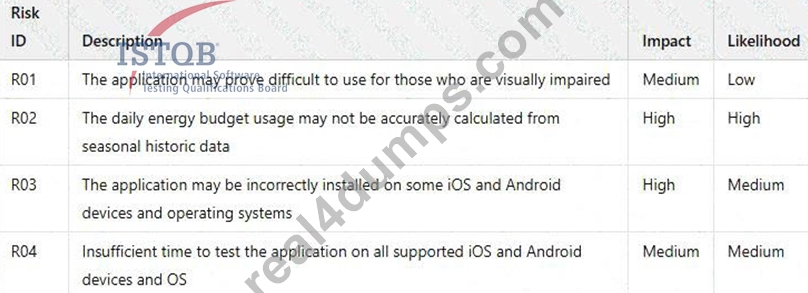
SELECT ONE OPTION
- A. R04
- B. R03
- C. R02
- D. R01
Answer: B
Explanation:
Comprehensive and Detailed in Depth Explanation:
Since the question focuses onIterations 1 and 2 only, we must prioritize risks related to these iterations.
* R01(Accessibility): Low likelihood, medium impact - not a priority for initial iterations.
* R02(Budget calculation): Related to Iteration 3, so it isnot relevantto the current test design.
* R03(Installation issues on iOS and Android): High impact, medium likelihood -relevantfor both Iterations 1 and 2. Installation is crucial for ensuring the application works on both platforms.
* R04(Insufficient testing time): Medium impact and likelihood - important, but R03 is more critical.
Hence, the highest priority risk to address first isR03 (The application may be incorrectly installed on some iOS and Android devices).
NEW QUESTION # 56
You are the Test Analyst reviewing a risk register and designing test conditions for the highest priority product risks related to Iterations 1 and 2 only.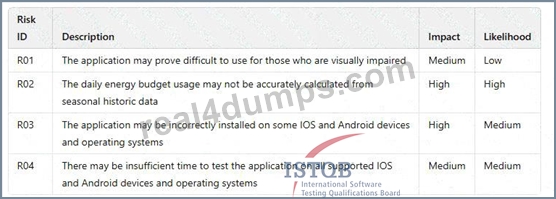
Which of the following product risks would you design test conditions for first?
SELECT ONE OPTION:
- A. R04
- B. R03
- C. R02
- D. R01
Answer: B
Explanation:
Comprehensive and Detailed In-Depth Explanation:
* R01:Low likelihood, not the highest priority.
* R02:Relates to Iteration 3, which is out of scope for Iterations 1 and 2.
* R03:High impact and medium likelihood, relevant to both IOS (Iteration 1) and Android (Iteration 2).
* R04:Medium impact and medium likelihood, less critical compared to R03.
Therefore, the correct answer isA (R03).
NEW QUESTION # 57
You are running a regression test suite using a keyword-driven test approach for automation. One of the new test cases using a new keyword failed unexpectedly. What should be your first step?
SELECT ONE OPTION
- A. Ask the technical test analyst to review the keyword script(s), as this is a new keyword and is the most likely cause of failure
- B. Examine the sequence of tests that led up to the failure to determine if the problem occurred in a previous step
- C. Remove the test case from the regression suite and convert it to a manual test to reduce further impact on project schedules
- D. Run the test case manually to see if the failure lies in the System Under Test (SUT). If the test fails manually, raise a defect report
Answer: D
Explanation:
Comprehensive and Detailed in Depth Explanation:
Since the issue occurred during the execution of anew test caseusing anew keyword, it is important to first isolate whether the problem lies within the System Under Test (SUT) or the automation scriptitself.
* C. Run the test case manually:This helps to verify if the problem is with theSUTor theautomation script. If the manual test also fails, it indicates a potentialdefect in the SUT, otherwise, it could be an issue with the new keyword or the automation script.
* A. Examine the sequence of tests:This is not the most efficient first step because it does not directly identify if the issue is with the SUT.
* B. Remove the test case:Prematurely removing the test case is not a good practice without investigation.
* D. Ask the technical test analyst:While it could be a keyword issue, manually verifying the test first is a more practical approach.
The correct answer isC (Run the test case manually to see if the failure lies in the System Under Test).
NEW QUESTION # 58
A new online application is being introduced for the start of the next tax year to handle tax liabilities.
This web-based system is especially aimed at those with visual disabilities and several innovative features are being introduced for the user interface. The design of these features is ongoing.
Which of the following represents the BEST approach for accessibility testing?
SELECT ONE OPTION
- A. Wait for the solution to be fully developed, then test during usability testing
- B. Consider accessibility when conducting system design and test from the integration level onwards
- C. Ensure that there are visually impaired people on the development team
- D. Incorporate testing for mobility impaired, deaf, and cognitively disabled users
Answer: B
Explanation:
Comprehensive and Detailed in Depth Explanation:
The best practice for accessibility testing is toconsider accessibility from the design stage onwards. By incorporating accessibility testing early, potential issues are detected and resolved during integration, rather than waiting for the full system to be completed.
* Option Ais impractical as it assumes that having visually impaired people in the development team will automatically ensure accessible design.
* Option Bsuggests a late-stage testing approach, which is less efficient.
* Option Dis not aligned with the primary focus on visual disabilities.
* Option Cis correct because addressing accessibility from the integration level onwards helps ensure that accessibility features are built into the system from the start.
NEW QUESTION # 59
......
ISTQB-CTAL-TA certification is a valuable credential for software testers who wish to advance their careers and demonstrate their expertise in test analysis. By passing the exam and obtaining the certification, candidates can demonstrate their commitment to excellence in software testing and increase their job opportunities in this highly competitive industry.
Pass ISTQB-CTAL-TA Exam - Real Questions and Answers: https://www.real4dumps.com/ISTQB-CTAL-TA_examcollection.html
Pass ISTQB-CTAL-TA Review Guide, Reliable ISTQB-CTAL-TA Test Engine: https://drive.google.com/open?id=1QGk8qSgNt5qcC1arC6UoVq2g64ARzdSm
