

Prepare JN0-253 Exam Questions [2025] Recently Updated Questions
Give push to your success with JN0-253 exam questions
NEW QUESTION # 28
In the Mist UI, what are two Marvis Actions for the AP category? (Choose two.)
- A. Coverage Hole
- B. Health Check Failed
- C. High CPU
- D. MTU Mismatch
Answer: A,B
Explanation:
Coverage Hole: Marvis Actions can identify coverage holes where the wireless signal is weak or absent, indicating potential areas that need additional access points or adjustments.
Health Check Failed: This action indicates that the health check, which monitors the performance and connectivity of an access point, has failed, suggesting issues that need to be addressed.
NEW QUESTION # 29
Which location-based service does User Engagement provide?
- A. Wi-Fi presence analytics
- B. ultra wide band location
- C. wayfinding
- D. asset tracking
Answer: A
NEW QUESTION # 30
Which statement describes Marvis Actions?
- A. It is a dashboard that details actions taken by the Marvis AI.
- B. It is a dashboard that lists the actions taken by wireless users.
- C. It is a dashboard that highlights actionable items.
- D. It is a dashboard that describes user actions.
Answer: C
Explanation:
Marvis Actions is a component of the Mist AI platform that provides a dashboard highlighting actionable items. This dashboard is designed to offer insights and recommendations based on the analysis performed by Marvis AI.
The focus of Marvis Actions is to present users with clear, actionable steps that can improve network performance, resolve issues, and enhance the overall user experience. By consolidating relevant information and suggested actions, Marvis Actions helps network administrators efficiently address network challenges and optimize operations.
NEW QUESTION # 31
Which unit of measurement is used for capacity, coverage, and throughput SLEs?
- A. percentage of channel utilization
- B. signal strength in dBm
- C. throughput in Mbps
- D. percentage of user minutes
Answer: C
Explanation:
For capacity, coverage, and throughput Service Level Expectations (SLEs) in Mist AI, throughput is measured in Mbps. This unit measures the rate at which data is successfully delivered over the wireless network, providing a clear indication of network performance and user experience. Mist AI tracks these metrics to ensure the network meets the required performance standards.
NEW QUESTION # 32
An AP is connected to your wired network but is not claimed to your organization.
Which type of AP would be a possible security threat in this scenario?
- A. honeypot AP
- B. neighbor AP
- C. spoofed AP
- D. rogue AP
Answer: D
Explanation:
Types of APs and Security Threats:
Understanding different types of access points and their potential security threats.
Access Point Types:
Neighbor AP: An access point that belongs to a neighboring network and is not necessarily a security threat.
Rogue AP: An unauthorized access point connected to the wired network, posing a significant security threat.
Spoofed AP: An access point that mimics a legitimate one, but typically does not involve being connected to the network.
Honeypot AP: An access point set up to lure attackers, not necessarily a threat unless used maliciously.
Identifying the Threat:
An AP connected to your wired network but not claimed to your organization is considered a rogue AP and poses a security threat.
NEW QUESTION # 33
The Mist Site Insights Dashboard helps network administrators in which two ways? (Choose two.)
- A. It identifies issues affecting an end user's network experience displayed as a percentage of success.
- B. It displays when a bad event has been logged.
- C. It identifies when a monitored component of the network has crossed a defined threshold.
- D. It displays information about the current WLANs.
Answer: A,C
NEW QUESTION # 34
Which two Wi-Fi related SLEs are visible in the Mist UI? (Choose two.)
- A. Application Health
- B. Switch Health
- C. Capacity
- D. Throughput
Answer: C,D
Explanation:
Wi-Fi Related SLEs in Mist UI:
SLEs (Service Level Expectations) help monitor and ensure Wi-Fi network performance.
Visible SLEs:
Capacity:
Capacity SLE monitors the network's ability to handle the number of connected clients and their bandwidth requirements.
Throughput:
Throughput SLE measures the data transfer rates, ensuring that the network meets the expected performance levels.
NEW QUESTION # 35
Referring to the exhibit, which two statements are correct? (Choose two.)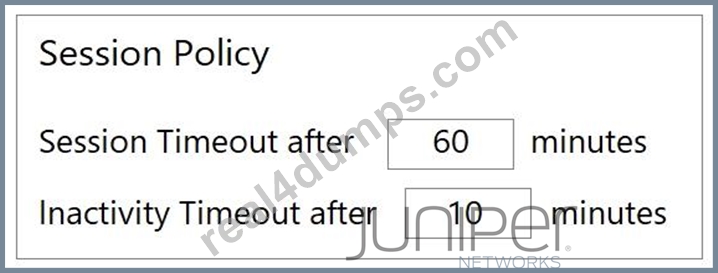
- A. You will need to log in to Mist every 60 minutes as long as you are viewing this organization.
- B. To stay logged in, you will need to perform an action in Mist every 10 minutes as long as you are viewing this organization.
- C. You will need to log in to Mist every 60 minutes regardless of which organization you are viewing.
- D. To stay logged in, you will need to perform an action in Mist every 10 minutes regardless of which organization you are viewing.
Answer: C,D
Explanation:
Session Timeout (60 minutes):
This timeout applies globally, meaning you will be logged out of Mist after 60 minutes of continuous session time, regardless of which organization you are working in.
Inactivity Timeout (10 minutes):
If there is no user activity for 10 minutes, you will be logged out automatically. This also applies globally, regardless of the organization being accessed.
NEW QUESTION # 36
Which two statements correctly describe Mist organizations and sites? (Choose two.)
- A. An organization is contained within a site.
- B. Multiple sites may be contained within a single organization.
- C. A site is contained within an organization.
- D. Multiple organizations may be contained within a single site.
Answer: B,C
Explanation:
In the Mist architecture, an organization is a higher-level entity that can contain multiple sites.
A site is contained within an organization: Each site operates under the umbrella of an organization, allowing centralized management and policy enforcement.
Multiple sites may be contained within a single organization: This structure enables organizations to manage and monitor different geographical locations or different business units within a single centralized framework.
This hierarchical structure facilitates scalable and organized network management.
NEW QUESTION # 37
Using the Mist UI, where do you look for high priority end-user issues on the network?
- A. Network Analytics
- B. Premium Analytics
- C. Occupancy Analytics
- D. Marvis Actions
Answer: D
NEW QUESTION # 38
Which two statements are correct about Juniper Mist Wired Assurance ZTP? (Choose two.)
- A. All legacy Juniper switch models are supported.
- B. The cloud-ready Juniper switch must either boot from the factory-default state or you can issue the request system zeroize Junos command to reset the configuration.
- C. The switch must be running a supported Junos version for Juniper Mist Wired Assurance.
- D. The technician must have console access to the switch during the initial setup.
Answer: B,C
Explanation:
Supported Junos Version: For Juniper Mist Wired Assurance to function correctly, the switch must be running a supported Junos version. This ensures compatibility with Mist's cloud management and AI capabilities.
Factory-Default State or Zeroize Command: The switch must boot from a factory-default state, or you can use the request system zeroize command to reset its configuration. This is essential for seamless onboarding and auto-provisioning.
NEW QUESTION # 39
Which two Mist location tracking components run in the cloud? (Choose two.)
- A. location sensor
- B. location system
- C. location engine
- D. BLE tag
Answer: B,C
Explanation:
Location Engine: The location engine runs in the cloud and processes data from BLE tags and sensors to determine the location of devices within a network. It performs the necessary computations to provide accurate location tracking and analytics.
Location System: The location system, also cloud-based, integrates with the location engine to provide a complete solution for tracking and managing location data within Mist's ecosystem. This system supports various applications such as asset tracking, wayfinding, and proximity-based services.
NEW QUESTION # 40
According to Juniper Networks, what are two best practices for AP placement (excluding AP12) for optimal accuracy and stability of location-based services? (Choose two.)
- A. Enable a wireless mesh.
- B. Mount the AP above the ceiling, the LED orientation does not matter.
- C. Mount the AP on the ceiling with the LED facing the floor.
- D. Each AP should have an unobstructed fine of sight to at least two other APs.
Answer: C,D
Explanation:
Line of Sight: For optimal accuracy and stability of location-based services, each access point (AP) should have an unobstructed line of sight to at least two other APs. This ensures robust triangulation and accurate location tracking.
Ceiling Mounting: Mounting APs on the ceiling with the LED facing the floor is recommended.
This position provides the best coverage and performance for both Wi-Fi and BLE signals, essential for reliable location services.
NEW QUESTION # 41
Which two statements are correct about the Juniper Mist Wired Assurance brownfield adoption workflow? (Choose two.)
- A. The administrator must have the Juniper switch claim code available.
- B. The Juniper Mist QR code on the switch must be scanned by the technician.
- C. DNS resolution must be working on the Juniper switch.
- D. The same exact switch adoption CLI commands can be pasted into multiple different Juniper switches.
Answer: C,D
NEW QUESTION # 42
Which two statements correctly describe the encryption of traffic using Mist? (Choose two.)
- A. By default, the communication between a Wi-Fi client and an AP is encrypted.
- B. By default, the communication between an AP and a RADIUS server is not encrypted.
- C. By default, the communication between a Wi-Fi client and an AP is not encrypted.
- D. By default, the communication between an AP and a RADIUS server is encrypted.
Answer: A,B
Explanation:
AP and RADIUS Server Communication: By default, the communication between an Access Point (AP) and a RADIUS server is not encrypted. This can be configured to be encrypted, but it is not the default setting.
Wi-Fi Client and AP Communication: By default, the communication between a Wi-Fi client and an AP is encrypted, typically using WPA2 or WPA3, which ensures the data exchanged over the wireless network is secure.
NEW QUESTION # 43
Which Mist supported API is considered data-driven?
- A. Webhook
- B. WebSocket
- C. RESTful
- D. gRPC
Answer: C
NEW QUESTION # 44
......
Get JN0-253 Actual Free Exam Q&As to Prepare Certification: https://www.real4dumps.com/JN0-253_examcollection.html
JN0-253 100% Guarantee Download JN0-253 Exam PDF Q&A: https://drive.google.com/open?id=1mO9C-ZrwKsO_QY4OTFb8Zda3f-vFQuWy
