

Achieve The Utmost Performance In CKA Exam Pass Guaranteed
Achive your Success with Latest Linux Foundation CKA Exam
Linux Foundation CKA Exam Syllabus Topics:
| Topic | Details |
|---|---|
| Topic 1 |
|
| Topic 2 |
|
| Topic 3 |
|
| Topic 4 |
|
| Topic 5 |
|
| Topic 6 |
|
| Topic 7 |
|
| Topic 8 |
|
| Topic 9 |
|
The Need for CNCF CKA Certification Exam
The CNCF Certified Kubernetes Administrator exam is designed to test the knowledge of candidates on deploying, managing, and troubleshooting applications on Kubernetes clusters. Answers to the CNCF Certified Kubernetes Administrator exam questions can be found in the official study guide. Real world experience and hands-on configuration and troubleshooting is critical to passing any certification exam. Real world experience will put candidates in good stead for the CNCF Certified Kubernetes Administrator exam. Download the study guide and start studying for the exam. CNCF CKA exam dumps can be accessed from certain test providers. The CNCF CKA exam dumps will provide the candidate with the knowledge to pass the exam. Application of knowledge from the study guide to real life configuration will help candidates pass the CNCF Certified Kubernetes Administrator exam. Updates on the official definition of each question will be available on the Brightwork website. Understanding questions on Kubernetes in the CNCF Certified Kubernetes Administrator exam is subject to change. Understanding real-world configuration and troubleshooting is central to passing the CNCF Certified Kubernetes Administrator exam.
NEW QUESTION 34
Create a nginx pod that will be deployed to node with the label
"gpu=true"
- A. kubectl run nginx --image=nginx --restart=Always --dry-run -o
yaml > nodeselector-pod.yaml
// add the nodeSelector like below and create the pod
kubectl apply -f nodeselector-pod.yaml
vim nodeselector-pod.yaml
apiVersion: v1
kind: Pod
metadata:
name: nginx
spec:
nodeSelector:
gpu: true
yaml
//Verify
kubectl get no -show-labels
kubectl get po
kubectl describe po nginx | grep Node-Selectors - B. kubectl run nginx --image=nginx --restart=Always --dry-run -o
yaml > nodeselector-pod.yaml
// add the nodeSelector like below and create the pod
kubectl apply -f nodeselector-pod.yaml
vim nodeselector-pod.yaml
apiVersion: v1
kind: Pod
metadata:
name: nginx
spec:
nodeSelector:
gpu: true
containers:
- image: nginx
name: nginx
restartPolicy: Always
kubectl apply -f nodeselector-pod.yaml
//Verify
kubectl get no -show-labels
kubectl get po
kubectl describe po nginx | grep Node-Selectors
Answer: B
NEW QUESTION 35
Score: 4%
Task
Set the node named ek8s-node-1 as unavailable and reschedule all the pods running on it.
Answer:
Explanation:
SOLUTION:
[student@node-1] > ssh ek8s
kubectl cordon ek8s-node-1
kubectl drain ek8s-node-1 --delete-local-data --ignore-daemonsets --force
NEW QUESTION 36
Clean the cluster by deleting deployment and hpa you just created
Answer:
Explanation:
kubectl delete deploy webapp kubectl delete hpa webapp
NEW QUESTION 37
An Administrator is configuring Authentication Enforcement and they would like to create an exemption rule to exempt a specific group from authentication. Which authentication enforcement object should they select?
- A. default-no-captive-port
- B. default-browser-challenge
- C. default-authentication-bypass
- D. default-web-form
Answer: A
NEW QUESTION 38
List all persistent volumes sorted bycapacity, saving the fullkubectloutput to
/opt/KUCC00102/volume_list. Usekubectl 's own functionality forsorting the output, and do not manipulate it any further.
Answer:
Explanation:
See the solution below.
Explanation
solution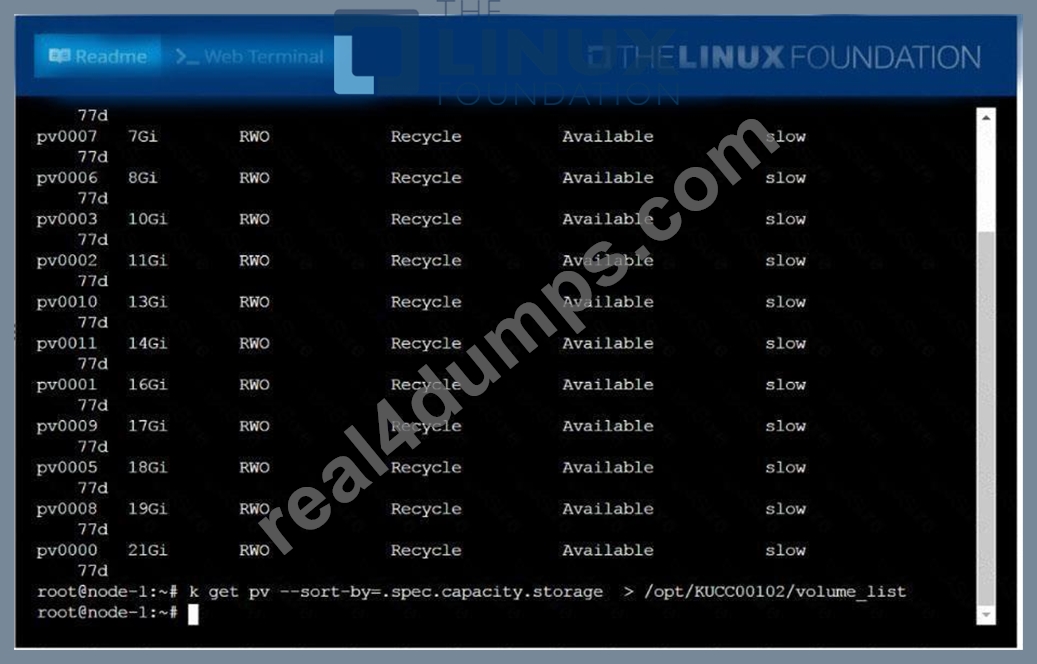
NEW QUESTION 39
Create a redis pod and expose it on port 6379
- A. kubectl run redis --image=redis --restart=Never --port=6379
YAML File :
apiVersion: v1
kind: Pod
metadata:
labels:
run: redis
name: redis
spec:
containers:
ports:
- containerPort: 6679
Rt restartPolicy: Alwaysf - B. kubectl run redis --image=redis --restart=Never --port=6379
YAML File :
apiVersion: v1
kind: Pod
metadata:
labels:
run: redis
name: redis
spec:
containers:
- image: redis
name: redis
ports:
- containerPort: 6379
Rt restartPolicy: Always
Answer: B
NEW QUESTION 40
A bootstrap USB flash drive has been prepared using a Linux workstation to load the initial configuration of a Palo Alto Networks firewall. The USB flash drive was formatted using file system ntfs and the initial configuration is stored in a file named init-cfg.txt.
The contents of Init-cfg.txt in the USB flash drive are as follows:
type=static
ip-address=10.5.107.19
default-gateway=10.5.107.1
netmask=255.255.255.0
Ipv6-address=2001:400:100::1/64
ipv6-default-gateway=2001:400:100::2
hostname=Ca-FW-DC1
panorama-server=10.5.107.20
panorama-server-2=10.5.107.21
tplname=FINANCE TG4
dgname=finance_dg
dns-primary=10.5.6.6
op-command-modes multi-vsys.jumbo-frame
dhcp-send-hostname=no
dhcp-send-client-id=no
dhcp-accept-server-hostname=no
dhcp-accept-server-domain=no
The USB flash drive has been inserted in the firewalls' USB port, and the firewall has been powered on.Upon boot, the firewall fails to begin the bootstrapping process. The failure is caused because:
- A. nit-cfg bit is an incorrect filename the correct filename should be init-ofg.xml
- B. The USB drive has been formatted with an unsupported file system
- C. There must be commas between the parameter names and their values instead of the equal symbols
- D. The USB must be formatted using the ext4 file system
- E. The bootstrap.xml file is a required file, but it is missing
Answer: D
NEW QUESTION 41
Get the DNS records for the service and pods for the deployment redis and the put the value in /tmp/dnsrecordpod and /tmp/dnsrecord-service
- A. // Get Pod Ip
kubectl get po -o wide
// Get Service Name
kubectl get svc
// Create a temporary pod and execute nslookup command
Note: POD IP format should be a-b-c-d and not a.b.c.d
kubectl run busybox --image=busybox:1.28 --restart=Never -
-rm -it -- nslookup 192-168-0-69.default.pod >
/tmp/dnsrecord-pod
kubectl run busybox1 --image=busybox:1.28 --restart=Never
--rm -it -- nslookup redis-service > /tmp/dnsrecordservice
//Verify
cat /tmp/dnsrecord-pod
Server: 10.2.0.10
Address 1: 10.2.0.10 kube-dns.kube system.svc.cluster.local Name: 192-168-0-69.default.pod Address 1: 192.168.0.69 192-168-0-69.redis service.default.svc.cluster.local cat /tmp/dnsrecord-pod Server: 10.2.0.10 Address 1: 10.2.0.10 kube-dns.kube system.svc.cluster.local Name: 192-168-0-69.default.pod Address 1: 192.168.0.69 192-168-0-69.redis service.default.svc.cluster.local - B. // Get Pod Ip
kubectl get po -o wide
// Get Service Name
kubectl get svc
// Create a temporary pod and execute nslookup command
Note: POD IP format should be a-b-c-d and not a.b.c.d
kubectl run busybox --image=busybox:1.28 --restart=Never -
-rm -it -- nslookup 192-168-0-69.default.pod >
/tmp/dnsrecord-pod
kubectl run busybox1 --image=busybox:1.26 --restart=Never
--rm -it -- nslookup redis-service > /tmp/dnsrecordservice
//Verify
cat /tmp/dnsrecord-pod
Server: 10.2.8.10
Address 1: 10.2.0.10 kube-dns.kube system.svc.cluster.local Name: 192-168-0-69.default.pod Address 1: 192.168.0.69 192-166-0-69.redis service.default.svc.cluster.local cat /tmp/dnsrecord-pod Server: 10.2.0.10 Address 1: 10.2.0.10 kube-dns.kube system.svc.cluster.local Name: 192-168-0-69.default.pod Address 1: 192.168.0.69 192-168-0-69.redis service.default.svc.cluster.local
Answer: A
NEW QUESTION 42
Get list of all the pods showing name and namespace with a jsonpath expression.
Answer:
Explanation:
See the solution below.
Explanation
kubectl get pods -o=jsonpath="{.items[*]['metadata.name'
, 'metadata.namespace']}"
NEW QUESTION 43
Score:7%
Task
Create a new PersistentVolumeClaim
* Name: pv-volume
* Class: csi-hostpath-sc
* Capacity: 10Mi
Create a new Pod which mounts the PersistentVolumeClaim as a volume:
* Name: web-server
* Image: nginx
* Mount path: /usr/share/nginx/html
Configure the new Pod to have ReadWriteOnce access on the volume.
Finally, using kubectl edit or kubectl patch expand the PersistentVolumeClaim to a capacity of 70Mi and record that change.
Answer:
Explanation:
Solution:
vi pvc.yaml
storageclass pvc
apiVersion: v1
kind: PersistentVolumeClaim
metadata:
name: pv-volume
spec:
accessModes:
- ReadWriteOnce
volumeMode: Filesystem
resources:
requests:
storage: 10Mi
storageClassName: csi-hostpath-sc
# vi pod-pvc.yaml
apiVersion: v1
kind: Pod
metadata:
name: web-server
spec:
containers:
- name: web-server
image: nginx
volumeMounts:
- mountPath: "/usr/share/nginx/html"
name: my-volume
volumes:
- name: my-volume
persistentVolumeClaim:
claimName: pv-volume
# craete
kubectl create -f pod-pvc.yaml
#edit
kubectl edit pvc pv-volume --record
NEW QUESTION 44
List all persistent volumes sorted by capacity, saving the full kubectl output to /opt/KUCC00102/volume_list. Use kubectl 's own functionality for sorting the output, and do not manipulate it any further.
Answer:
Explanation:
solution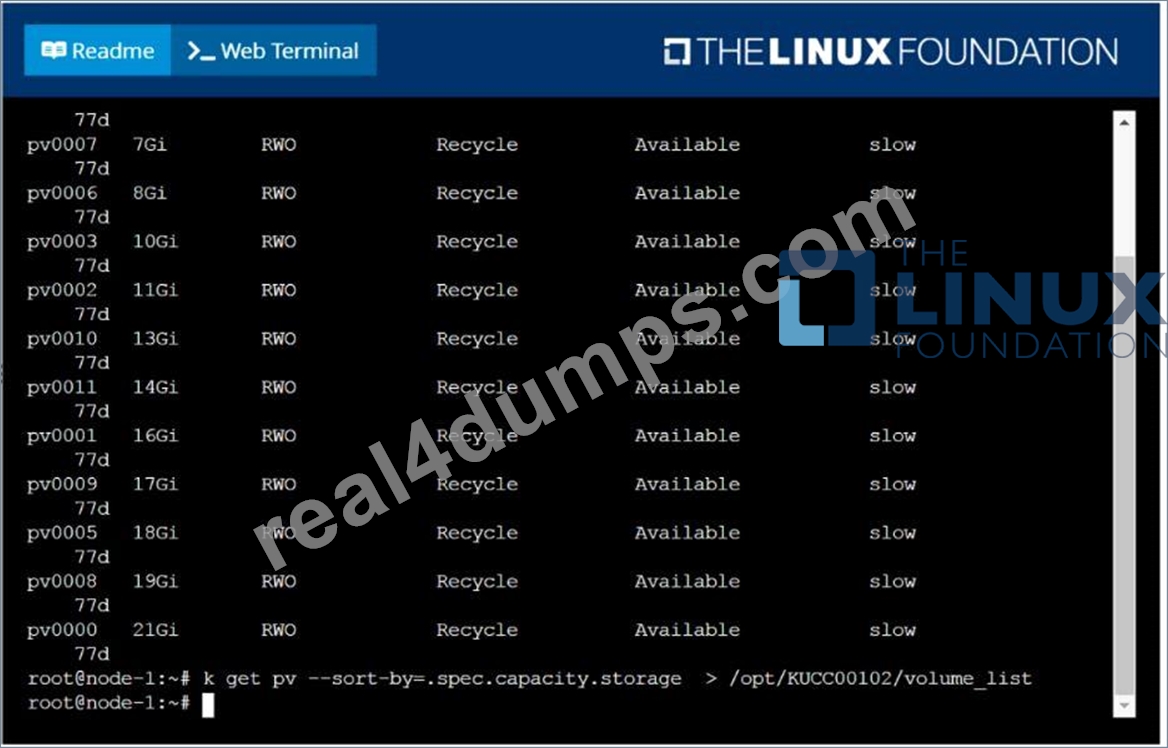
NEW QUESTION 45
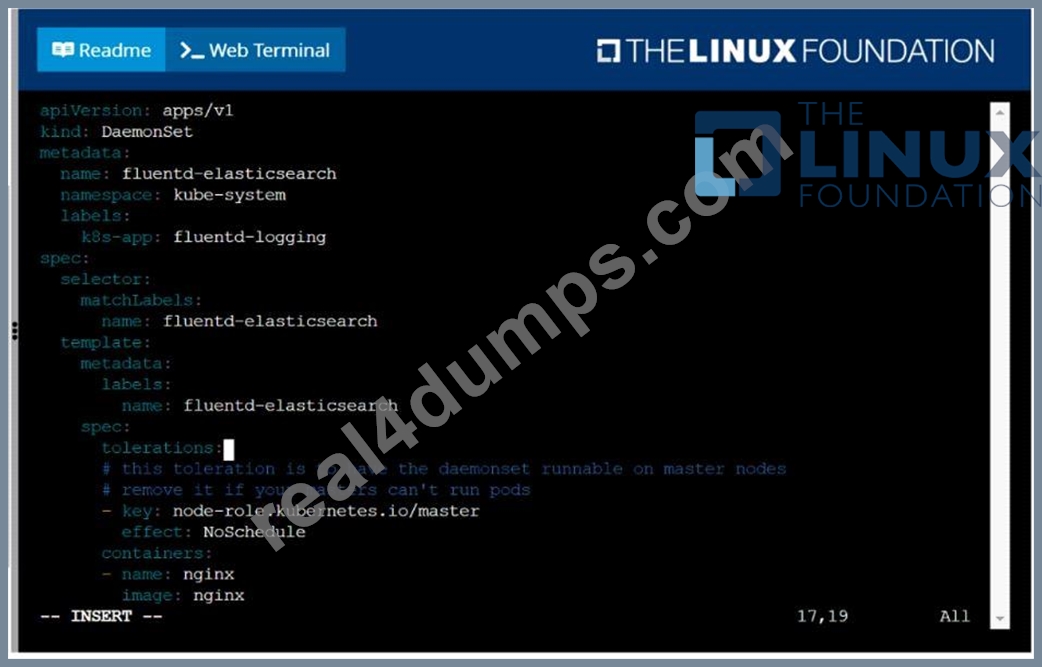
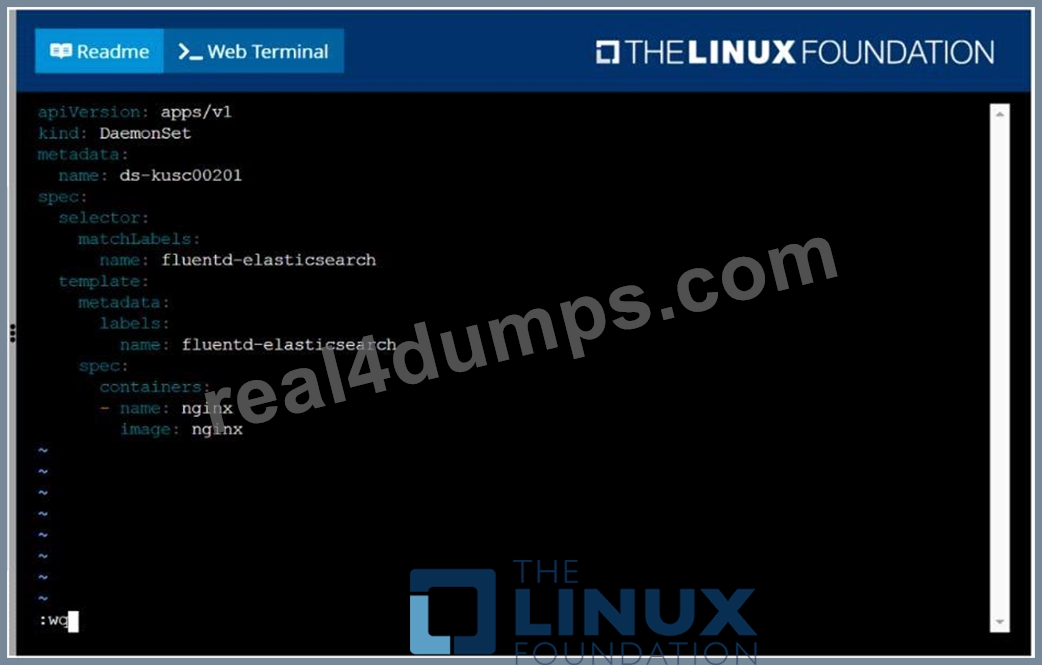
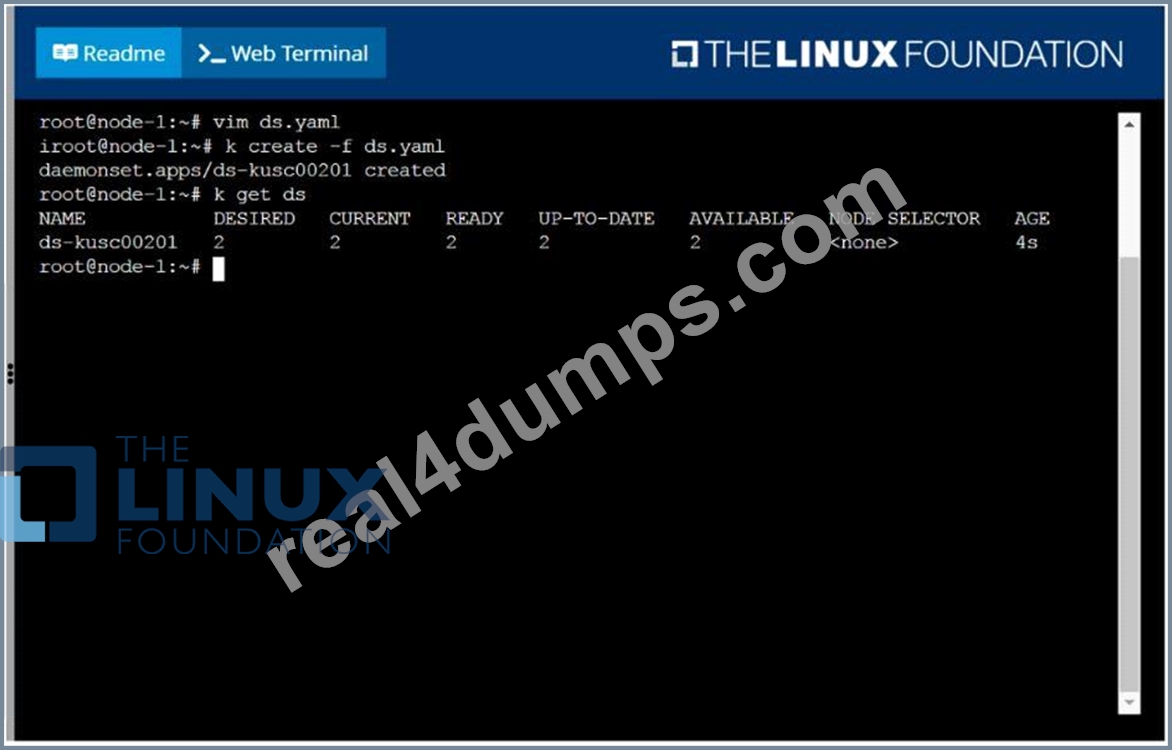
Ensure a single instance of pod nginx is running on each node of the Kubernetes cluster where nginx also represents the Image name which has to be used. Do not override any taints currently in place.
Use DaemonSet to complete this task and use ds-kusc00201 as DaemonSet name.
Answer:
Explanation:
solution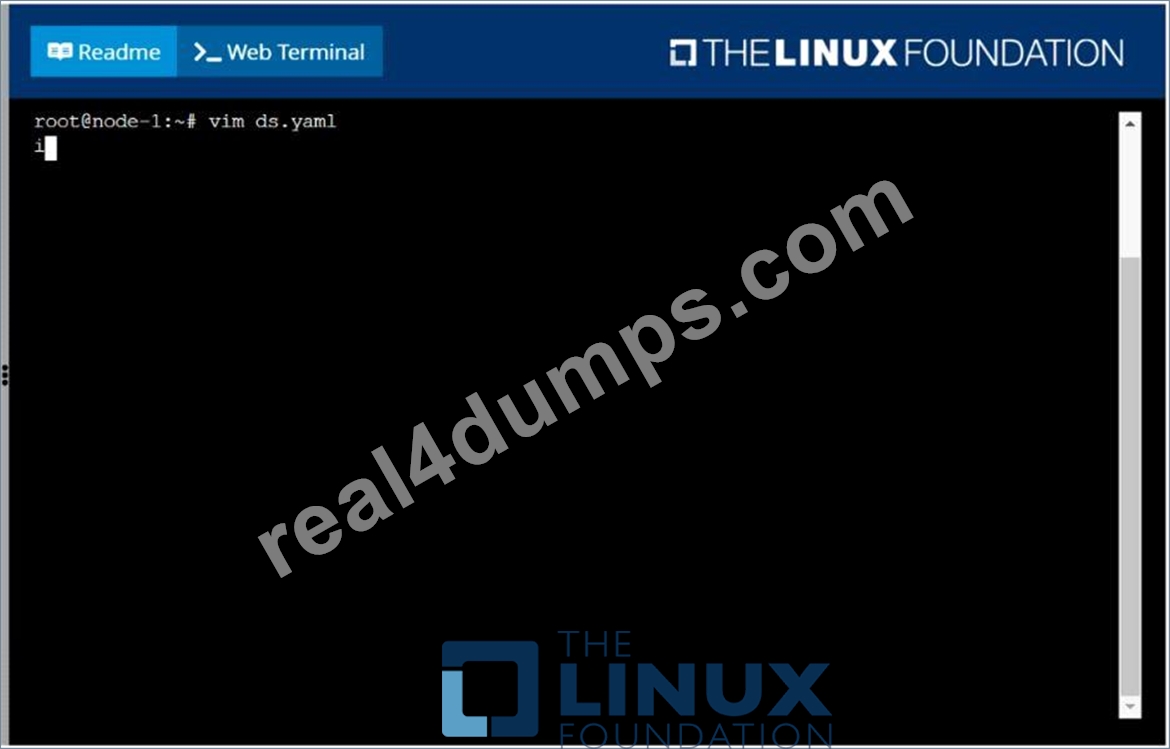
NEW QUESTION 46
Create a configmap called cfgvolume with values var1=val1,
var2=val2 and create an nginx pod with volume nginx-volume which
reads data from this configmap cfgvolume and put it on the path
/etc/cfg
- A. // first create a configmap cfgvolume
kubectl create cm cfgvolume --from-literal=var1=val1 --fromliteral=var2=val2
// verify the configmap
kubectl describe cm cfgvolume
// create the config map
kubectl create -f nginx-volume.yml
vim nginx-configmap-pod.yaml
apiVersion: v1
kind: Pod
metadata:
labels:
run: nginx
name: nginx
spec:
volumes:
- name: nginx-volume
configMap:
name: cfgvolume
containers:
- image: nginx
name: nginx
volumeMounts:
- name: nginx-volume
mountPath: /etc/cfg
restartPolicy: Always
k kubectl apply -f nginx-configmap-pod.yaml
/ // Verify
// exec into the pod
kubectl exec -it nginx -- /bin/sh
// check the path
cd /etc/cfg - B. // first create a configmap cfgvolume
kubectl create cm cfgvolume --from-literal=var1=val1 --fromliteral=var2=val2
// verify the configmap
kubectl describe cm cfgvolume
// create the config map
kubectl create -f nginx-volume.yml
vim nginx-configmap-pod.yaml
apiVersion: v1
kind: Pod
- name: nginx-volume
configMap:
name: cfgvolume
containers:
- image: nginx
name: nginx
volumeMounts:
- name: nginx-volume
mountPath: /etc/cfg
restartPolicy: Always
k kubectl apply -f nginx-configmap-pod.yaml
/ // Verify
// exec into the pod
kubectl exec -it nginx -- /bin/sh
// check the path
cd /etc/cfg
Answer: A
NEW QUESTION 47
A Kubernetes worker node, named .Investigate why this is the case,
andperform any appropriate steps tobring the node to a state,ensuring that any changes are madepermanent.
You cansshto the failednode using:
[student@node-1] $ | sshWk8s-node-0
You can assume elevatedprivileges on the node with thefollowing command:
[student@w8ks-node-0] $ |sudo -i
Answer:
Explanation:
See the solution below.
Explanation
solution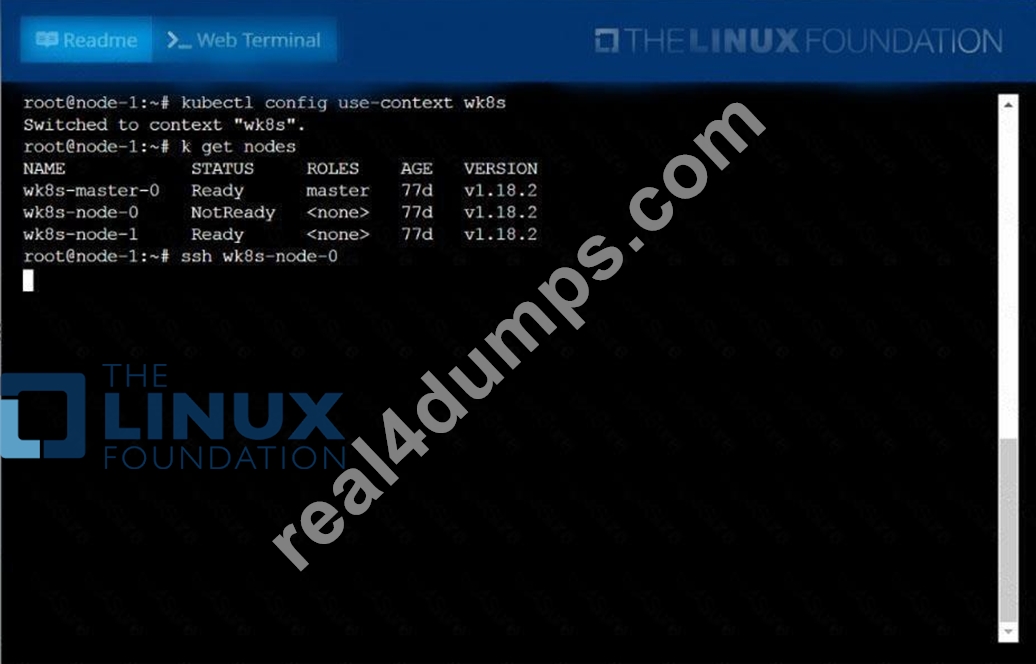
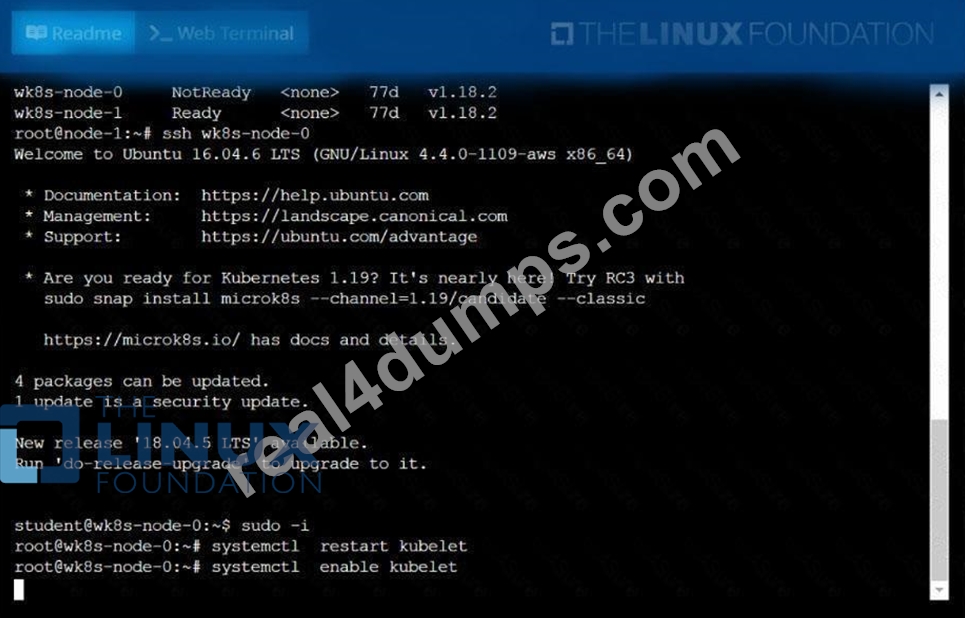
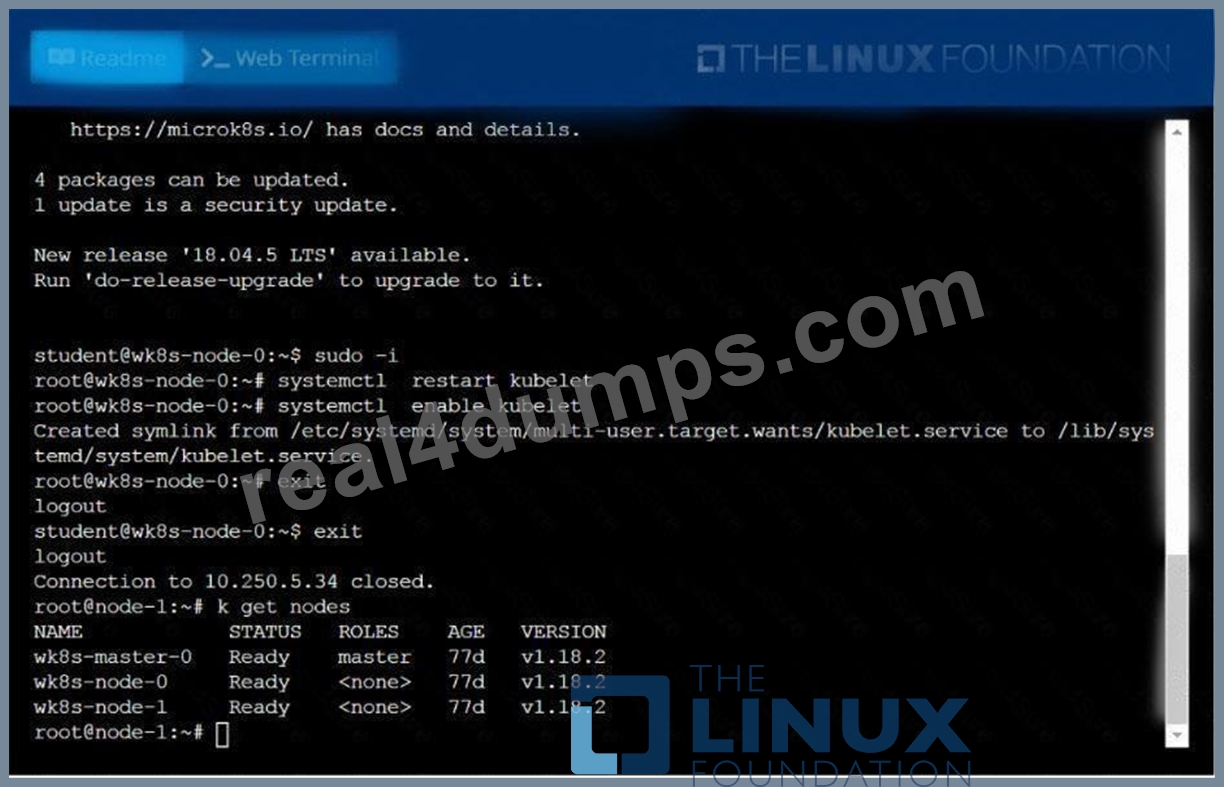
NEW QUESTION 48
Check the history of deployment
Answer:
Explanation:
kubectl rollout history deployment webapp
NEW QUESTION 49
Deployment
a. Create a deployment of webapp with image nginx:1.17.1 with
container port 80 and verify the image version
- A. // Create initial YAML file with -dry-run option
kubectl create deploy webapp --image=nginx:1.17.1 --dryrun=client -o yaml > webapp.yaml vim webapp.yaml apiVersion: apps/v1 kind: Deployment metadata:
labels:
app: webapp
name: webapp
spec: replicas: 1 containers: - image: nginx:1.17.1 name: nginx kubectl create -f webapp.yaml -record=true //Verify Image Version kubectl describe deploy webapp | grep -i "Image" Using JsonPath kubectl get deploy -o=jsonpath='{range.items [*]}{.[*]} {.metadata.name}{"\t"}{.spec.template.spec.containers[*].i mage}{"\n"}' - B. // Create initial YAML file with -dry-run option
kubectl create deploy webapp --image=nginx:1.17.1 --dryrun=client -o yaml > webapp.yaml vim webapp.yaml apiVersion: apps/v1 kind: Deployment metadata:
labels:
app: webapp
name: webapp
spec: replicas: 1 selector: matchLabels: app: webapp template: metadata: labels: app: webapp spec: containers: - image: nginx:1.17.1 name: nginx kubectl create -f webapp.yaml -record=true //Verify Image Version kubectl describe deploy webapp | grep -i "Image" Using JsonPath kubectl get deploy -o=jsonpath='{range.items [*]}{.[*]} {.metadata.name}{"\t"}{.spec.template.spec.containers[*].i mage}{"\n"}'
Answer: B
NEW QUESTION 50
From the pod label name=cpu-utilizer, find pods running high CPU workloads and write the name of the pod consuming most CPU to the file /opt/KUTR00102/KUTR00102.txt (which already exists).
Answer:
Explanation:
See the solution below.
Explanation
solution
F:\Work\Data Entry Work\Data Entry\20200827\CKA\16 B.JPG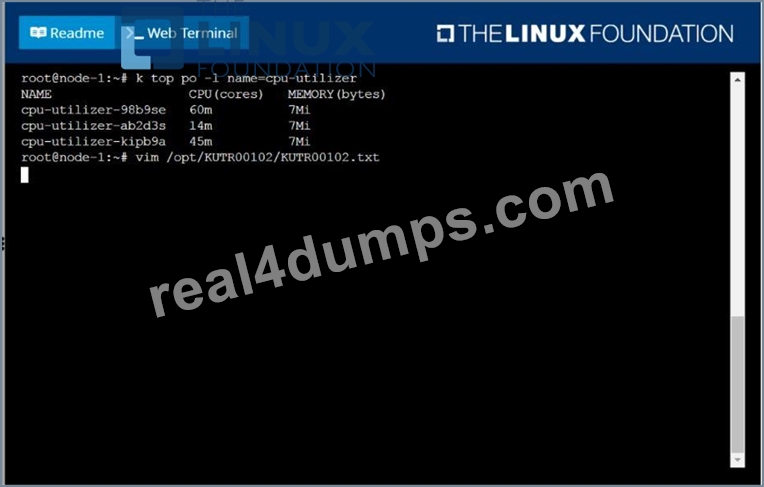
F:\Work\Data Entry Work\Data Entry\20200827\CKA\16 C.JPG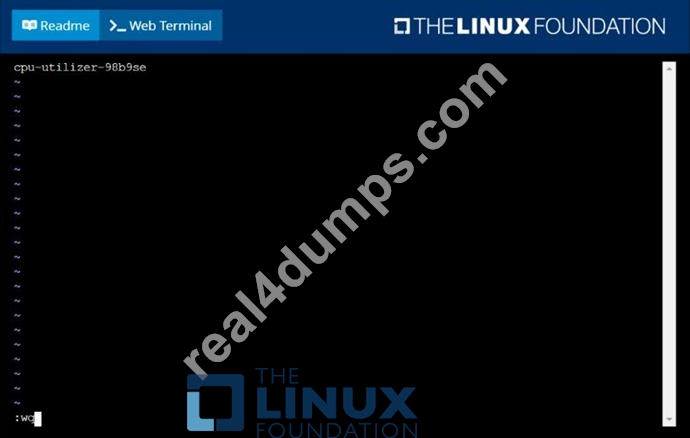
NEW QUESTION 51
List the nginx pod with custom columns POD_NAME and POD_STATUS
Answer:
Explanation:
kubectl get po -o=custom-columns="POD_NAME:.metadata.name, POD_STATUS:.status.containerStatuses[].state"
NEW QUESTION 52
Get list of all the pods showing name and namespace with a jsonpath expression.
Answer:
Explanation:
kubectl get pods -o=jsonpath="{.items[*]['metadata.name' , 'metadata.namespace']}"
NEW QUESTION 53
Verify certificate expiry date for ca certificate in /etc/kubernetes/pki
Answer:
Explanation:
openssl x509 -in ca.crt -noout -text | grep -i validity -A 4
NEW QUESTION 54
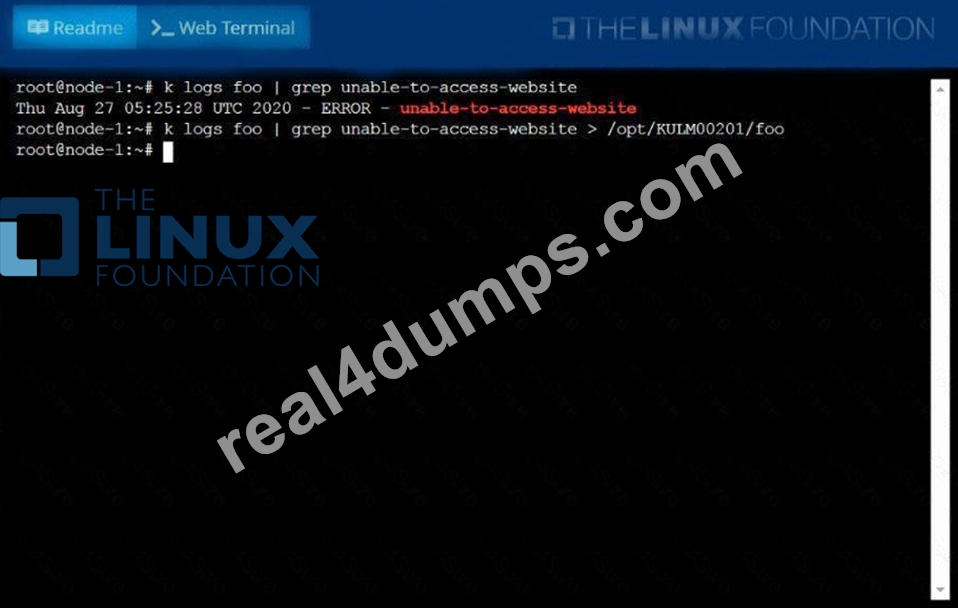
Monitor the logs of pod foo and:
* Extract log lines corresponding to error
unable-to-access-website
* Write them to/opt/KULM00201/foo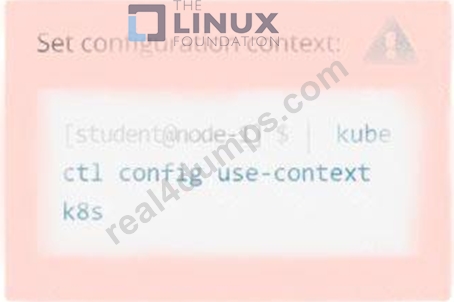
Answer:
Explanation:
See the solution below.
Explanation
solution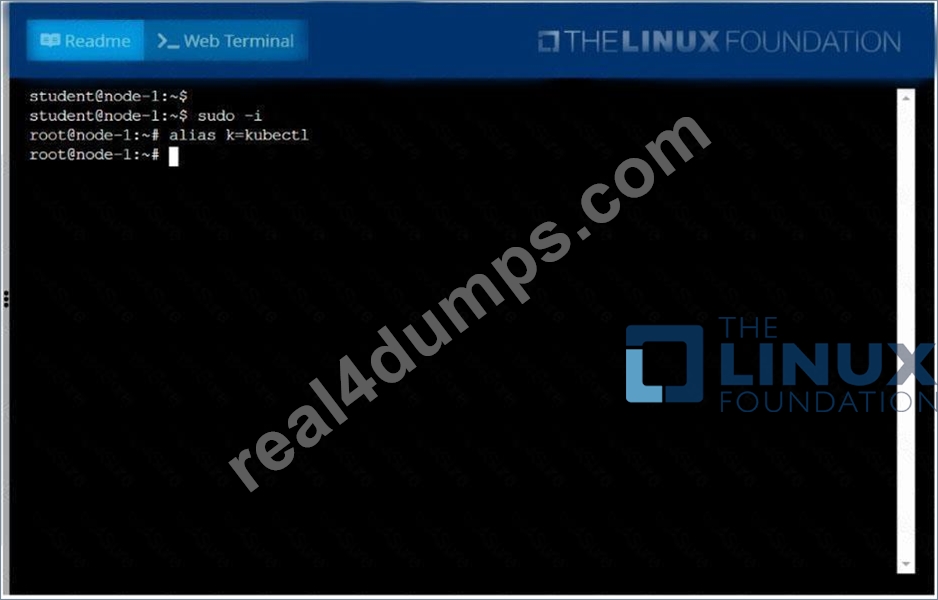
NEW QUESTION 55
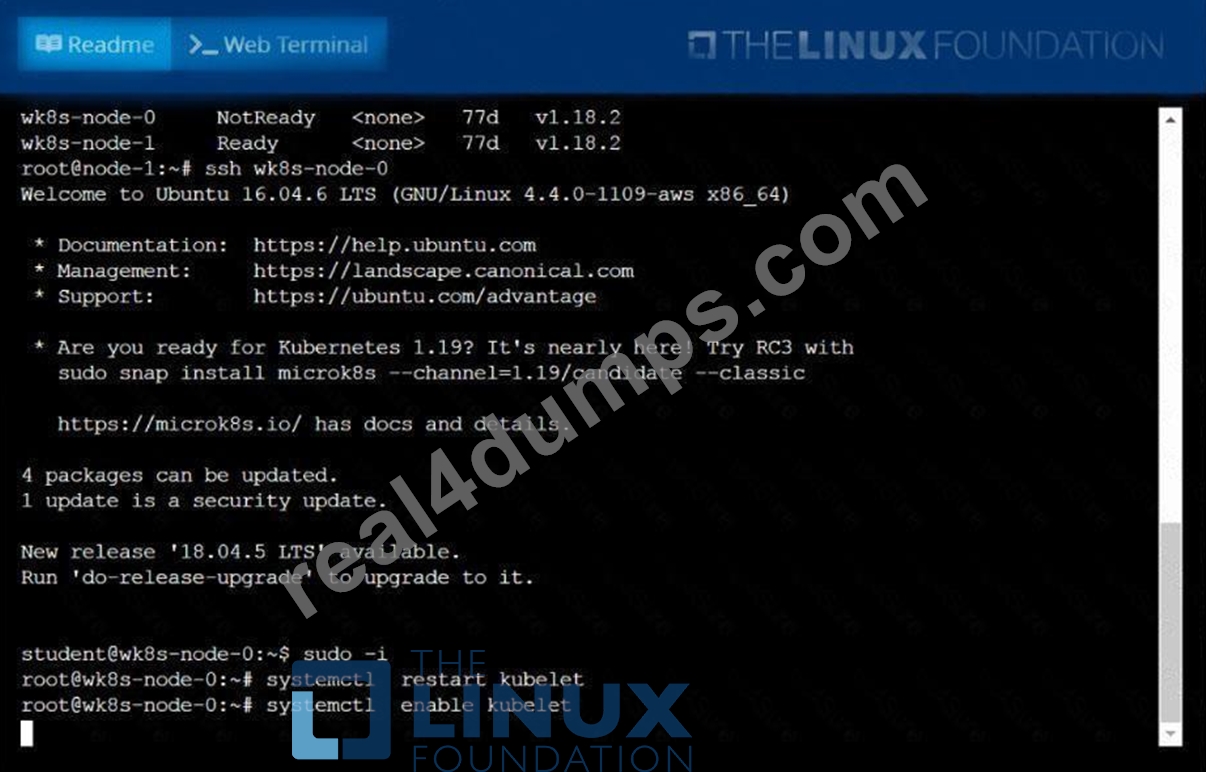
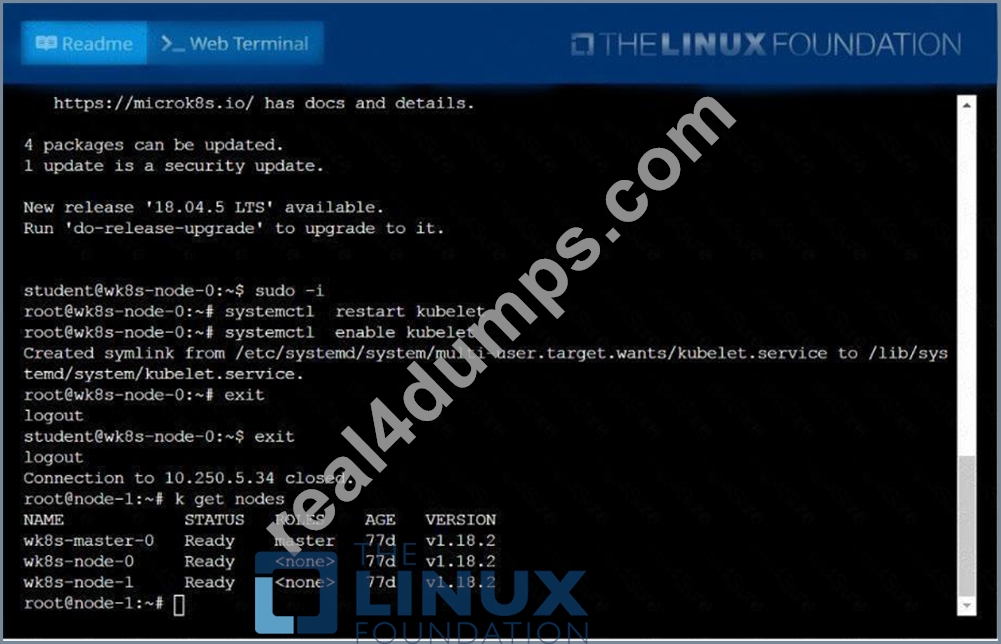
A Kubernetes worker node, named wk8s-node-0 is in state NotReady. Investigate why this is the case, and perform any appropriate steps to bring the node to a Ready state, ensuring that any changes are made permanent.
You can ssh to the failed node using:
[student@node-1] $ | ssh Wk8s-node-0
You can assume elevated privileges on the node with the following command:
[student@w8ks-node-0] $ | sudo -i
Answer:
Explanation:
See the solution below.
Explanation
solution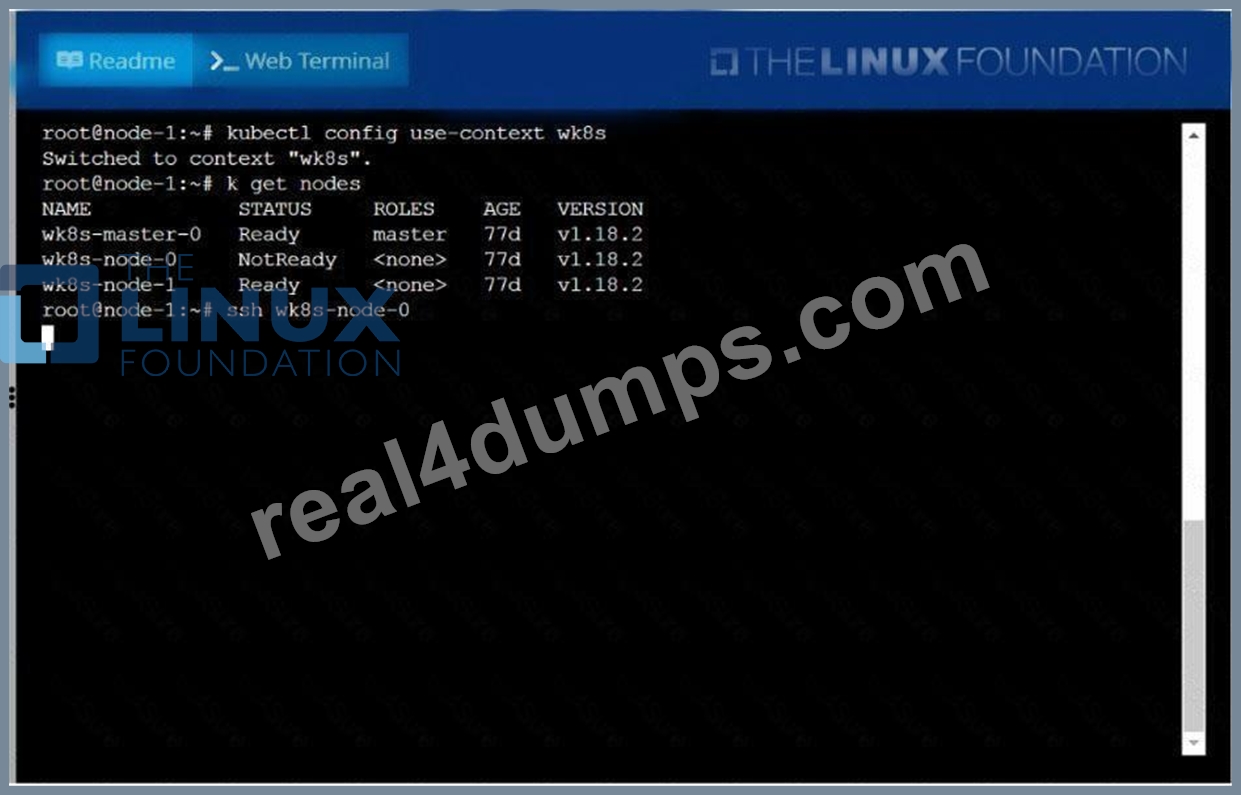
NEW QUESTION 56
Task Weight: 4%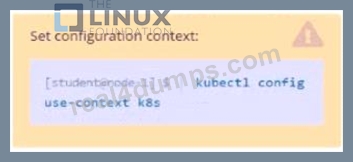
Task
Scale the deployment webserver to 3 pods.
Answer:
Explanation:
Solution:
NEW QUESTION 57
Create a pod as follows:
* Name:mongo
* Using Image:mongo
* In anew Kubernetes namespacenamed:my-website
Answer:
Explanation:
See the solution below.
Explanation
solution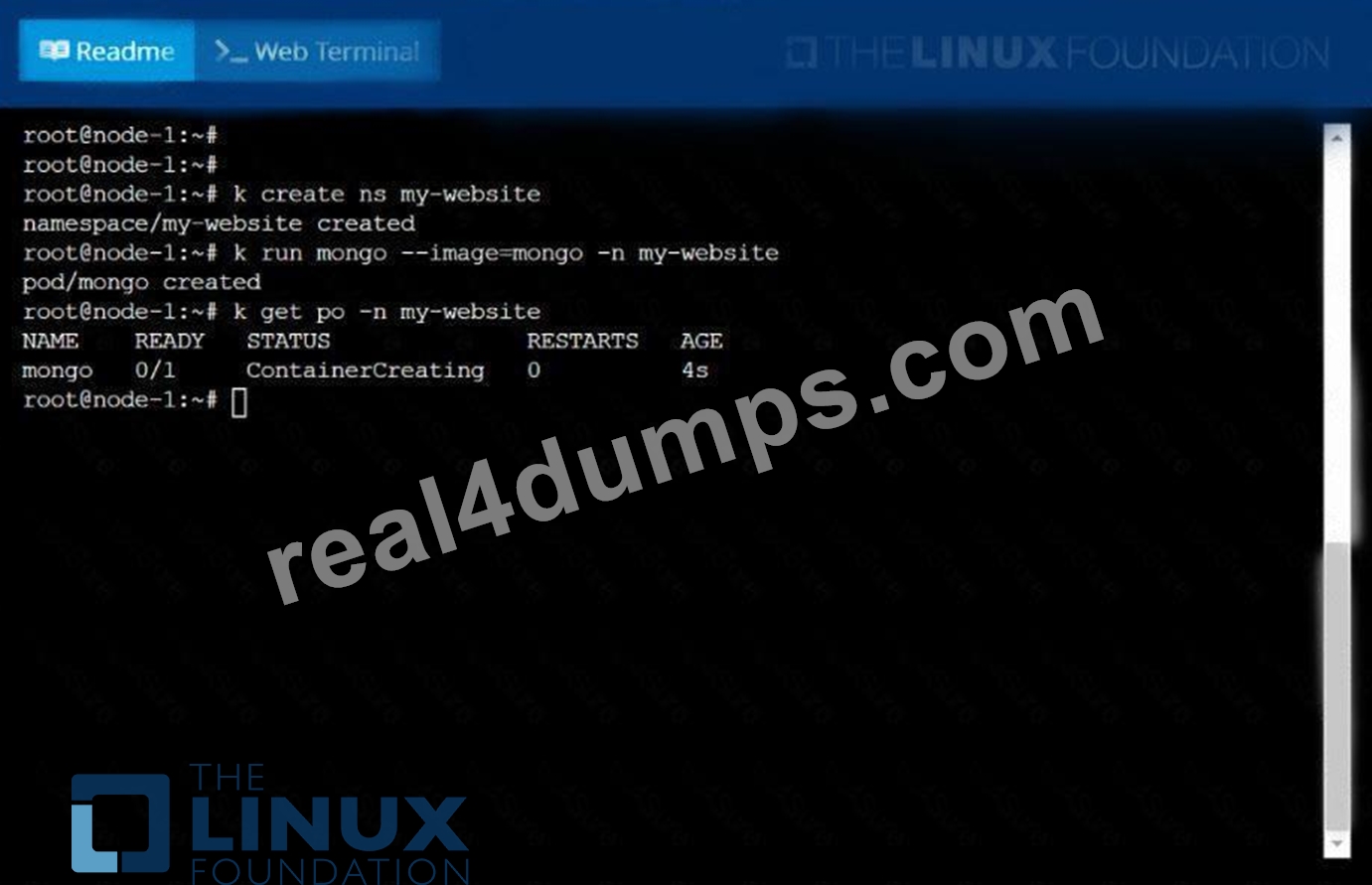
NEW QUESTION 58
Create a pod as follows:
* Name: mongo
* Using Image: mongo
* In a new Kubernetes namespace named
Answer:
Explanation:
See the solution below.
Explanation
solution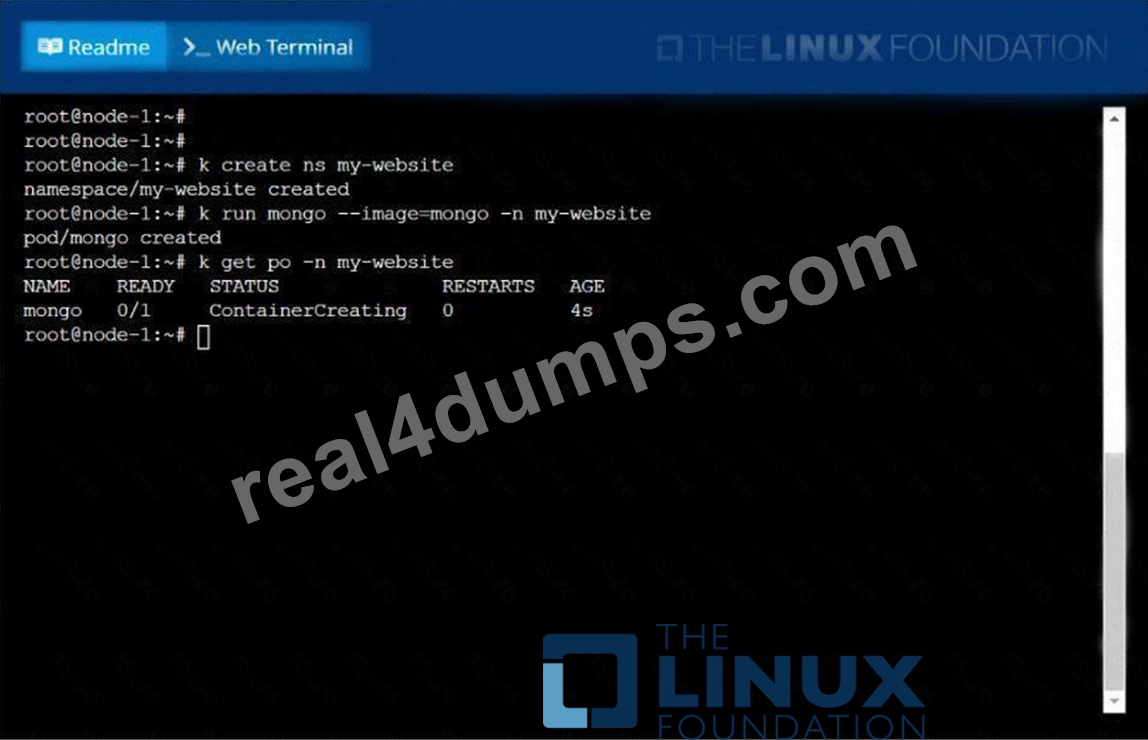
NEW QUESTION 59
......
Revolutionary Guide To Exam Linux Foundation Dumps: https://www.real4dumps.com/CKA_examcollection.html
The CKA Exam Test For Brief Preparation: https://drive.google.com/open?id=11uAk7Huj6xziD5rwyvxMCXri5VMs1V9X
