

Practice on 2023 LATEST MCD-Level-1 Exam Updated 226 Questions
Download Latest MCD-Level-1 Dumps with Authentic Real Exam QA's
NEW QUESTION 71
Refer to the exhibit.
In the execution of the Scatter-Gather, the "steep 1 sec" Flow Reference takes about 1 second to complete, and the "sleep 5 sees" Row Reference takes about 5 seconds to complete.
About how many seconds does it take from the time the Scatter-Gather is called until the Set Payload transformer is called?
- A. 0
- B. 1
- C. 2
- D. 3
Answer: B
NEW QUESTION 72
Refer to the exhibits.
What payload and quantity are togged at the end of the main flow?
- A. [[1,2,3,4], 14]
- B. [[1,2,3,4], 10]
- C. [[order1, order2, order3, order4], 14]
- D. [orderlorder2order3order4, 14]
Answer: A
NEW QUESTION 73
Refer to the exhibit.
A Mule event is composed of a hierarchy of objects. Where in the hierarchy are variables stored?
- A. Mule event
- B. Mule message attributes
- C. Mule message
- D. Mule message payload
Answer: A
Explanation:
Variables are stored under Mule event. Please refer to below image for the hierarchy .

NEW QUESTION 74
A flow has a JMS Publish consume operation followed by a JMS Publish operation. Both of these operations have the default configurations. Which operation is asynchronous and which one is synchronous?
- A. Publish consume: Synchronous. Publish: Asynchronous.
- B. Publish consume: Synchronous. Publish: Synchronous
- C. Publish consume: Asynchronous. Publish: Synchronous
- D. Publish consume: Asynchronous. Publish: Asynchronous
Answer: A
Explanation:
Publish consume: Synchronous. Publish: Asynchronous.
NEW QUESTION 75
Refer to the exhibits.

A web client submits a request to http://localhQst:8081. What is the structure of the payload at the end of the flow?
A)
B)
C)
D)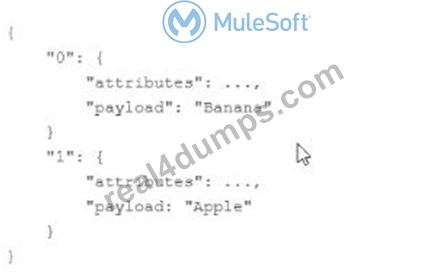
- A. Option B
- B. Option C
- C. Option D
- D. Option A
Answer: C
Explanation:
Scatter-Gather sends the event to each routes concurrently and returns a collection of all results. Collection is an Object of Objects. Each object contains attributes and payload from each Mule event returned from a flow. Hence option 4 is the correct answer.
NEW QUESTION 76
What valid RAML retrieves details on a specific by its orderld as a URL parameter?
A)
B)
C)
D)
- A. Option B
- B. Option C
- C. Option A
- D. Option D
Answer: A
NEW QUESTION 77
Which of the below is not the mandatory configurations for HTTP Listener?
- A. Path
- B. HTTP port in Connector Configuration
- C. HTTP host in Connector Configuration
- D. Allowed methods
Answer: D
Explanation:
Allowed methods is an optional configuration. If nothing is specified then all HTTP methods are supported.
Rest all are mandatory.
NEW QUESTION 78
Refer to the exhibits.

A web client sends a POST request to the HTTP Listener with the payload "Hello-". What response is returned to the web client?
What response is returned to the web client?
- A. Hello-HTTP-Three
- B. Hello- HTTP-] MS2-Three
- C. HTTP-JMS2-Three
- D. Helb-JMS1-HTTP-JMS2 -Three
Answer: B
NEW QUESTION 79
Refer to the exhibits.

A Mule application contains a Choice router. What is logged when the flow completes?
- A. EU
- B. "REGION"
- C. ["US", "EU"]
- D. US
Answer: A
NEW QUESTION 80
An API instance of type API endpoint with API proxy is created in API manager using an API specification from Anypoint Exchange. The API instance is also configured with an API proxy that is deployed and running in CloudHub.
An SLA- based policy is enabled in API manager for this API instance.
Where can an external API consumer obtain a valid client ID and client secret to successfully send requests to the API proxy?
- A. In the organization's public API portal in Anypoint Exchange, from an approved client application for the API proxy
- B. In Anypoint Studio, from components generated by APIkit for the API specification
- C. In Anypoint Studio, from components generated by Rest Connect for API specification
- D. In Runtime Manager, from the properties tab of the deployed approved API proxy
Answer: A
Explanation:
* When a client application is registered in Anypoint Platform, a pair of credentials consisting of a client ID and client secret is generated.
* When the client application requests access to an API, a contract is created between the application and that API.
* An API that is protected with a Client ID Enforcement policy is accessible only to applications that have an approved contract.
--------------------------------------------------------------------------------------------------------------------------------------------- Correct answer: In the organization's public API portal in Anypoint Exchange, from an approved client application for the API proxy
NEW QUESTION 81
Refer to the exhibit.
What is the response to a web client request to http://localhost:8081?
- A. After
- B. null
- C. before
- D. Validation Error
Answer: A
NEW QUESTION 82
Refer to the exhibit.
The error occurs when a project is run in Anypoint Studio. The project, which has a dependency that is not in the MuleSoft Maven repository, was created and successfully run on a different computer.
What is the next step to fix the error to get the project to run successfully?
- A. Add the dependency to the MULE_HOME/bin folder
- B. Install the dependency to the computer's local Maven repository
- C. Deploy the dependency to MuleSoft's Maven repository
- D. Edit the dependency in the Mule project's pom.xml file
Answer: B
NEW QUESTION 83
Refer to the exhibits.

The main flow contains a Flow Reference component configured to call the child flow What part(s) of a Mule event passed to the Flow Reference component are available in the child flow?
- A. The payload
- B. The payload and all variables
- C. The entire Mule event
- D. The payload and all attributes
Answer: B
NEW QUESTION 84
Refer to the exhibit.
What is the correct syntax to add an employee ID as a URI parameter in an HTTP Listener path?
- A. ${emp!oyeelD}
- B. (employeelD)
- C. {employeelD}
- D. # [employeelD]
Answer: C
NEW QUESTION 85
Refer to the exhibits.
What payload and variable are logged at the end of the main flow?
- A. [[5, 10, 15, 20], 1]
- B. [Req5Req10,Req15Req20, 5]
- C. [[5, 10, 15, 20], 5]
- D. [[Req5, Req10, Req15, Req20], 5]
Answer: C
Explanation:
Correct answer is [[5, 10, 15, 20], 5]
Key thing to note here is that any changes made to payload in for each loop are not available outside for each scope where as variable value updated in for each loop is visible out side for each loop too.
NEW QUESTION 86
Refer to the exhibits.
What payload and quantity are togged at the end of the main flow?
- A. [[1,2,3,4], 14]
- B. [[1,2,3,4], 10]
- C. [[order1, order2, order3, order4], 14]
- D. [orderlorder2order3order4, 14]
Answer: A
NEW QUESTION 87
Refer to the exhibits. The Set Payload transformer in the addltem child flow uses DataWeave to create an order object.
What is the correct DataWeave code for the Set Payload transformer in the createOrder flow to use the addltem child flow to add a router call with the price of 100 to the order?
- A. addltem( { price: "100", item: "router", itemType: "cable" } )
- B. lookup( "addltern", { price: "100", item: "router", itemType: "cable" } )
- C. lookup( "addltem", { payload: { price: "100", item: "router", itemType: "cable" } > )
- D. addltem( { payload: { price: "100", item: "router", itemType: "cable" > } )
Answer: C
NEW QUESTION 88
As a part of project requirement , you want to build an API for a legacy client. Legacy client can only consume SOAP webservices. Which type the interface documentation can be prepared to meet the requirement?
- A. plain text file documenting API's
- B. RAML file to define SOAP services
- C. WSDL file
- D. JSON file
Answer: C
Explanation:
Web Services Description Language. WSDL is used to describe SOAP based web services
NEW QUESTION 89
......
MuleSoft MCD-Level-1 Exam Syllabus Topics:
| Topic | Details |
|---|---|
| Topic 1 |
|
| Topic 2 |
|
| Topic 3 |
|
| Topic 4 |
|
| Topic 5 |
|
| Topic 6 |
|
| Topic 7 |
|
| Topic 8 |
|
Authentic MCD-Level-1 Exam Dumps PDF - Mar-2023 Updated: https://www.real4dumps.com/MCD-Level-1_examcollection.html
