

Pass MCD-Level-2 Exam in First Attempt Guaranteed 2024 Dumps!
MCD-Level-2 Dumps Full Questions - Exam Study Guide
NEW QUESTION # 15
A Mule application defines as SSL/TLS keystore properly 'tis,keystore.keyPassword'' as secure.
How can this property be referenced to access its value within the application?
- A. ${secure::tiskeystore,keyPassowrd}
- B. p{secure::tiskeystore,keyPassowrd}
- C. #{secure::tiskeystore,keyPassowrd}
- D. ${secure::tiskeystore,keyPassowrd}
Answer: D
Explanation:
Explanation
secure::tiskeystore,keyPassowrdShortExplanationofCorrectAnswerOnly:Toreferenceasecurepropertyvaluewithin In this case, the property name is tiskeystore,keyPassword, so the correct syntax is
${secure::tiskeystore,keyPassowrd}. References:
https://docs.mulesoft.com/mule-runtime/4.3/secure-configuration-properties#referencing-secure-properties
NEW QUESTION # 16
A developer is working on a project that requires encrypting all data before sending it to a backend application. To accomplish this, the developer will use PGP encryption in the Mule 4 Cryptography module.
What is required to encrypt the data before sending it to the backend application?
- A. The application needs to configure HTTPS TLS context information to encrypt the data
- B. The application needs the private key from the backend service to encrypt the data
- C. The application needs the public key from the backend service to encrypt the data
- D. The application needs to both the private and public keys to encrypt the data
Answer: C
Explanation:
Explanation
To encrypt the data before sending it to the backend application using PGP encryption, the application needs the public key from the backend service. PGP encryption uses a public-key cryptography system, which means that each party has a pair of keys: a public key and a private key. The public key is used to encrypt data, and the private key is used to decrypt data. Therefore, to encrypt data for a specific recipient (the backend service), the application needs to use the recipient's public key. The recipient can then use its own private key to decrypt the data. References: https://docs.mulesoft.com/mule-runtime/4.3/cryptography-pgp
NEW QUESTION # 17
The flow is invoicing a target API. The API's protocol is HTTPS. The TLS configuration in the HTTP Request Configuration global element is set to None. A web client submits a request to
http:localhost:8081/vehicles.
If the certificate of the target API is signed by a certificate authority (CA), what is true about the HTTP Request operation when the flow executes?
- A. The HTTP Request operation will succeed if the CA's certificate is present in the JRE's default truststore.
- B. The HTTP Request operation will always fail regardless of the CA
- C. The HTTP Request operation will always succeed regardless of the CA
- D. The HTTP Request operation will succeed if the CA'S certificate is present in the JRE's default keystore
Answer: A
Explanation:
Explanation
The HTTP Request operation will use the default truststore of the JRE to validate the certificate of the target API. If the CA's certificate is present in the truststore, the operation will succeed. Otherwise, it will fail with a handshake exception. References: https://docs.mulesoft.com/mule-runtime/4.3/tls-configuration#tls-default
NEW QUESTION # 18
A Mule application includes a subflow containing a Scatter.Gather scope. Within each log of the Scatter.Gatter. an HTTP connector calls a PUT endpoint to modify records in different upstream system. The subflow is called inside an Unit successful scope to retry if a transitory exception is raised.
A technical spike is being performed to increase reliability of the Mule application.
Which steps should be performed within the Mule flow above the ensure idempontent behavior?
- A. Ensure an error-handling flow performs corrective actions to roll back all changes if any leg of the Scatter-Gather fails
- B. None, the flow already exhibits idempotent behavior
- C. Remove the Put requests from the Scatter-Getter and perform them sequentially
- D. Change the PUT requests inside the Scatter-Gather to POST requests
Answer: A
Explanation:
Explanation
To ensure idempotent behavior within a Mule flow that contains a subflow with a Scatter-Gather scope, the developer should ensure an error-handling flow performs corrective actions to roll back all changes if any leg of the Scatter-Gather fails. Idempotency means that multiple identical requests have the same effect as a single request. Therefore, if one of the HTTP requests inside the Scatter-Gather fails, the error-handling flow should undo any changes made by other successful requests to ensure consistency and avoid partial updates.
References: https://docs.mulesoft.com/mule-runtime/4.3/scatter-gather-concept
https://docs.mulesoft.com/mule-runtime/4.3/error-handling
NEW QUESTION # 19
Which statement is true when working with correlation IDS?
- A. The HTTP Listener regenerates correlation IDs regardless of the HTTP request
- B. The VM Connector does not automatically propagate correction IDs
- C. The Anypoint MQ Connector automatically propagates correlation IDS
- D. The HTTP Listener generates correlation IDS unless a correlation ID is received in the HTTP request
Answer: D
Explanation:
Explanation
When working with correlation IDs, the HTTP Listener generates correlation IDs unless a correlation ID is received in the HTTP request. In that case, it propagates the received correlation ID throughout the flow execution. Correlation IDs are used to track events across different flows or applications. References:
https://docs.mulesoft.com/mule-runtime/4.3/about-mule-message#message-attributes
NEW QUESTION # 20
When implementing a synchronous API where the event source is an HTTP Listener, a developer needs to return the same correlation ID back to the caller in the HTTP response header.
How can this be achieved?
- A. Configure a custom correlation policy
- B. Enable the auto-generate CorrelationID option when scaffolding the flow
- C. Enable the CorrelationID checkbox in the HTTP Listener configuration
- D. NO action is needed as the correlation ID is returned to the caller in the response header by default
Answer: D
Explanation:
Explanation
When implementing a synchronous API where the event source is an HTTP Listener, Mule automatically propagates some message attributes between flows via outbound and inbound properties. One of these attributes is correlation ID, which is returned to the caller in the response header by default as MULE_CORRELATION_ID. References:
https://docs.mulesoft.com/mule-runtime/4.3/about-mule-message#message-attributes
NEW QUESTION # 21
A developer has created the first version of an API designed for business partners to work commodity prices.
What should developer do to allow more than one major version of the same API to be exposed by the implementation?
- A. In Anypoint Studio, generate scaffolding from the RAML, and the modify the <http:listerner> in the generated flows to include a parameter to replace the version number
- B. In Design Center, open the RAML and modify each operation to include the major version number
- C. In Anypoint Studio, generate scaffolding from the RAML, and then modify the flow names generated by APIKit to include a variable with the major version number
- D. In Design Center, open the RAML and modify baseUn to include a variable that indicates the version number
Answer: D
Explanation:
Explanation
To allow more than one major version of the same API to be exposed by the implementation, the developer should modify the baseUri property in the RAML file to include a variable that indicates the version number.
The baseUri property defines the base URL of the API and can include variables that are replaced with actual values when mocking or deploying the API. By using a variable for the version number, the developer can expose different versions of the API using different base URLs and avoid conflicts or confusion. References:
https://docs.mulesoft.com/api-designer/design-modify-raml-specs#baseuri
https://docs.mulesoft.com/api-manager/2.x/api-versioning
NEW QUESTION # 22
A heathcare customer wants to use hospital system data, which includes code that was developed using legacy tools and methods. The customer has created reusable Java libraries in order to read the data from the system.
What is the most effective way to develop an API retrieve the data from the hospital system?
- A. Include the libraries writes deploying the code into the runtime
- B. Install libraries in a local repository and refer to it in the pm.xml file
- C. Create the Java code in your project and invoice the data from the code
- D. Refer to JAR files in the code
Answer: B
Explanation:
Explanation
To develop an API that retrieves data from a hospital system using reusable Java libraries, the developer should install libraries in a local repository and refer to it in the pom.xml file. This way, the developer can use Maven to manage dependencies and invoke Java code from Mule applications using Java Module operations.
References:
https://docs.mulesoft.com/mule-runtime/4.3/java-module-reference#add-the-java-module-to-your-project
https://docs.mulesoft.com/mule-runtime/4.3/java-module-reference#invoke-java-code
NEW QUESTION # 23
A new Mule project has been created in Anypoint Studio with the default settings.
Which file inside the Mule project must be modified before using Maven to successfully deploy the application?
- A. Mule.artificact.json
- B. Pom.xml
- C. Settings.xml
- D. Config.yaml
Answer: B
Explanation:
Explanation
To use Maven to successfully deploy the application, the developer needs to modify the pom.xml file inside the Mule project. The pom.xml file contains the configuration and dependencies of the Mule application, as well as the deployment information such as the CloudHub region, environment, and worker size. The developer needs to specify these properties in the pom.xml file before using Maven to deploy the application.
References: https://docs.mulesoft.com/mule-runtime/4.3/mmp-concept#application-deployment-descriptor
NEW QUESTION # 24
A Mule application for processing orders must log the order ID for every log message output.
What is a best practice to enrich every log message with the order ID?
- A. Use the Tracing module to set logging variables with a Mapped Diagnostic Context
- B. Set a flow variable and edit the log4/2.xml file to output the variable as part of the message pattern
- C. Create a custom XML SDK component to wrap the logger processor and automatically add the order ID within the connector
- D. Use flow variables within every logger processor to log the order ID
Answer: A
Explanation:
Explanation
To enrich every log message with the order ID, the developer should use the Tracing module to set logging variables with a Mapped Diagnostic Context (MDC). The Tracing module allows adding custom key-value pairs to log messages using MDC variables. The developer can use Set Logging Variables operation to set the order ID as an MDC variable and then use it in any logger processor within the same thread or event.
References: https://docs.mulesoft.com/tracing-module/1.0/tracing-module-reference#set-logging-variables
NEW QUESTION # 25
A Mule application uses API autodiscovery to access and enforce policies for a RESTful implementation.
- A. Any of the APIkit generate implement flows
- B. The name of the flow that has HTTP listener to receive all incoming RESTful operation requests
- C. Northing because flowRef is an optional attribute which can be passed runtime
- D. The name of the flow that has APlkit Console to receive all incoming RESTful operation requests.
Answer: B
Explanation:
Explanation
To use API autodiscovery to access and enforce policies for a RESTful implementation, flowRef must be set to the name of the flow that has HTTP listener to receive all incoming RESTful operation requests. This way, API autodiscovery can identify the API implementation and associate it with the corresponding API specification and policies in API Manager. The flow that has HTTP listener is usually the main flow that contains the APIKit Router. References:
https://docs.mulesoft.com/api-manager/2.x/api-auto-discovery-new-concept#flowref
NEW QUESTION # 26
Refer to the exhibit.
What required changes can be made to give a partial successful response in case the United Airlines API returns with a timeout?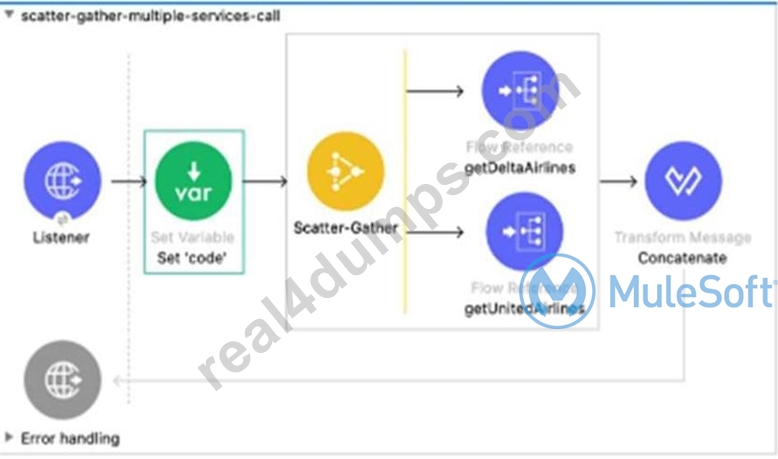
- A. Add a Scatter-Gather component inside a Try scope.
Set the payload to a default value 'Error'' inside the error handler using the On Error Continue scope. - B. Add Flow Reference components inside a Try scope.
Set the payload to a default value'' insider the error handler using the ON Error Continue scope - C. Add Flow Reference components inside a Try scope
Set the payload to a default value '' inside the error handler using the On Error Propagate scope - D. Add a Scatter-gather component inside a Try scope.
Set the payload to a default value 'Error' inside the error handler using the On Error Propagate scope.
Answer: A
Explanation:
Explanation
To give a partial successful response in case the United Airlines API returns with a timeout, the developer should add a Scatter-Gather component inside a Try scope, and set the payload to a default value 'Error' inside the error handler using the On Error Continue scope. A Scatter-Gather component allows sending multiple requests concurrently and aggregating the responses into an array. A Try scope allows handling errors that occur within it using an error handler. An On Error Continue scope allows continuing the flow execution after handling an error. Therefore, by using these components, the developer can send requests to both APIs in parallel, handle any timeout errors from United Airlines API, and return a partial response with a default value for that API. References: https://docs.mulesoft.com/mule-runtime/4.3/scatter-gather-concept
https://docs.mulesoft.com/mule-runtime/4.3/try-scope-concept
https://docs.mulesoft.com/mule-runtime/4.3/on-error-continue-concept
NEW QUESTION # 27
Which pattern should be used to invoke multiple HTTP APIs in parallel and roll back failed requests in sequence?
- A. VM queues as a reliability pattern with error handlers to roll back any requests
- B. Scatter-Gather as central Saga orchestrator for all API request with compensating actions for failing routes
- C. A Parallel for Each scope with each HTTP request wrapped in a Try scope
- D. A database as a transactional outbox and an Until Successful router to retry any requests
Answer: B
Explanation:
Explanation
To invoke multiple HTTP APIs in parallel and roll back failed requests in sequence, the developer should use a Scatter-Gather router as a central Saga orchestrator for all API requests with compensating actions for failing routes. A Scatter-Gather router executes multiple routes concurrently and aggregates the results. A Saga orchestrator coordinates a series of actions across different services and handles failures by executing compensating actions. Therefore, using a Scatter-Gather router as a Saga orchestrator allows invoking multiple HTTP APIs in parallel and rolling back any failed requests in sequence. References:
https://docs.mulesoft.com/mule-runtime/4.3/scatter-gather-concept
https://docs.mulesoft.com/mule-runtime/4.3/saga
NEW QUESTION # 28
A company with MuleSoft Titanium develops a Salesforce System API using MuleSoft out-of-the-box Salesforce Connector and deploys the API to CloudHub.
Which steps provide the average number of requests and average response time of the Salesforce Connector?
- A. Access Anypoint Monitoring's built-in dashboard
Seclect a resource.
Create a custom dashboard to retrieve the information. - B. Access Anypoint Monitoring built-in dashboard.
Select a resource.
Locate the information under Log Manager < Raw Data. - C. Change the API Implementation to capture the information in the log.
Retrieve the information from the log file. - D. Access Anypoint Monitoring's built-in dashboard. Select a resource.
Locate the information under the Connectors tab.
Answer: D
Explanation:
Explanation
To get the average number of requests and average response time of the Salesforce Connector, the developer should access Anypoint Monitoring's built-in dashboard, select a resource (such as an application or an API), and locate the information under the Connectors tab. The Connectors tab shows metrics for each connector used by the resource, such as average requests per minute, average response time, and failures. References:
https://docs.mulesoft.com/monitoring/built-in-dashboard-reference
NEW QUESTION # 29
A Mule API receives a JSON payload and updates the target system with the payload. The developer uses JSON schemas to ensure the data is valid.
How can the data be validation before posting to the target system?
- A. Use a DataWeave 2.09 transform operation, and at the log of the DataWeave script, add:
%dw 2.0
Import.json-moduls - B. Using the DataWeave if Else condition test the values of the payload against the examples included in the schema
- C. Add the JSON module dependency and add the validate-schema operation in the flow, configured to reference the schema
- D. Apply the JSON Schema policy in API Manager and reference the correct schema in the policy configuration
Answer: C
Explanation:
Explanation
To validate the data before posting to the target system, the developer should add the JSON module dependency and add the validate-schema operation in the flow, configured to reference the schema. The JSON module provides a validate-schema operation that validates a JSON payload against a JSON schema and throws an error if the payload is invalid. References:
https://docs.mulesoft.com/json-module/1.1/json-validate-schema
NEW QUESTION # 30
Two APIs are deployed to a two-node on-prem cluster. Due to a requirements change, the two APIs must communicate to exchange data asynchronously.
- A. The VM Connector is used to inter-application communication, so it is not possible to use the VM Connector
- B. If the two APIs use the same domain, the VM Connector can be leveraged
- C. It is not possible to use the VM Connector since the APIs are running in a cluster mode and each mode has it own set of VM Queues
- D. Instead of using the VM Connector use <flow-ref>directly
Answer: B
Explanation:
Explanation
To communicate asynchronously between two APIs deployed to a two-node on-prem cluster, the developer can use the VM Connector if the two APIs use the same domain. The VM Connector allows passing messages between different Mule applications within a single Mule runtime instance or across different instances using shared memory or persistent storage. If two APIs are deployed under the same domain, they can share resources such as VM queues and communicate asynchronously using VM Connector operations. References:
https://docs.mulesoft.com/mule-runtime/4.3/vm-connector
https://docs.mulesoft.com/mule-runtime/4.3/shared-resources
NEW QUESTION # 31
An API has been built to enable scheduling email provider. The front-end system does very little data entry validation, and problems have started to appear in the email that go to patients. A validate-customer'' flow is added validate the data.
What is he expected behavior of the 'validate-customer'' flow?
- A. If the appointment date and customer name are invalid, a
SCHEDULE:INVALID_APPOINTMENT_DATE error is raised - B. If all of the values are invalid the last validation error is
raised:SCHEDULE:INVALID_CUSTOMER_NAME - C. If the email address is invalid, processing continues to see if the appointment data and customer name are also invalid
- D. If only the email address Is invalid a VALIDATION.INVALID_EMAIL error is raised
Answer: D
Explanation:
Explanation
The validate-customer flow uses an until-successful scope to validate each field of the customer data. The until-successful scope executes its processors until they succeed or exhausts the maximum number of retries.
If any processor fails, it raises an error and stops executing the remaining processors. Therefore, if only the email address is invalid, a VALIDATION.INVALID_EMAIL error is raised and the validation of appointment date and customer name is skipped. References:
https://docs.mulesoft.com/mule-runtime/4.3/until-successful-scope
NEW QUESTION # 32
In a Mule project, Flow-1 contains a flow-ref to Flow-2 depends on data from Flow-1 to execute successfully.
Which action ensures the test suites and test cases written for Flow-1 and Flow-2 will execute successfully?
- A. Chain together the test suites and test cases for Flow-1 and Flow-2
- B. Use ''Set Event to pass the input that is needed, and keep the test cases for Flow-1 and Flow-2 independent
- C. Use 'After Test Case' to produce the data needed from Flow-1 test cases to pass to Flow-2 test cases
- D. Use ''Before Test Case'' To collect data from Flow-1 test cases before running Flow-2 test cases
Answer: B
Explanation:
Explanation
To ensure the test suites and test cases written for Flow-1 and Flow-2 will execute successfully, the developer should use a Set Event processor to pass the input that is needed by Flow-2, and keep the test cases for Flow-1 and Flow-2 independent. This way, the developer can isolate the testing of each flow and avoid coupling them together. References: https://docs.mulesoft.com/munit/2.3/munit-test-flow
NEW QUESTION # 33
......
MuleSoft Certified Developer Free Certification Exam Material from Real4dumps with 62 Questions: https://www.real4dumps.com/MCD-Level-2_examcollection.html
