

Verified 1Z0-082 Exam Dumps PDF [2022] Access using Real4dumps
Try Best 1Z0-082 Exam Questions from Training Expert Real4dumps
NEW QUESTION 23
Which is true about security rules on a compute node?
- A. A security rule can restrict IP addresses that can connect to a database instance on a compute node.
- B. A new database deployment on a compute node automatically enables a set of predefined security rules.
- C. A compute node port can be enabled only if it is associated with an existing security rule.
- D. New security rules can be defined to use only the TCP protocol but multiple port numbers.
- E. The port used for HTTPS connections is enabled by default based on a predefined security rule.
Answer: B
NEW QUESTION 24
Evaluate these commands which execute successfully: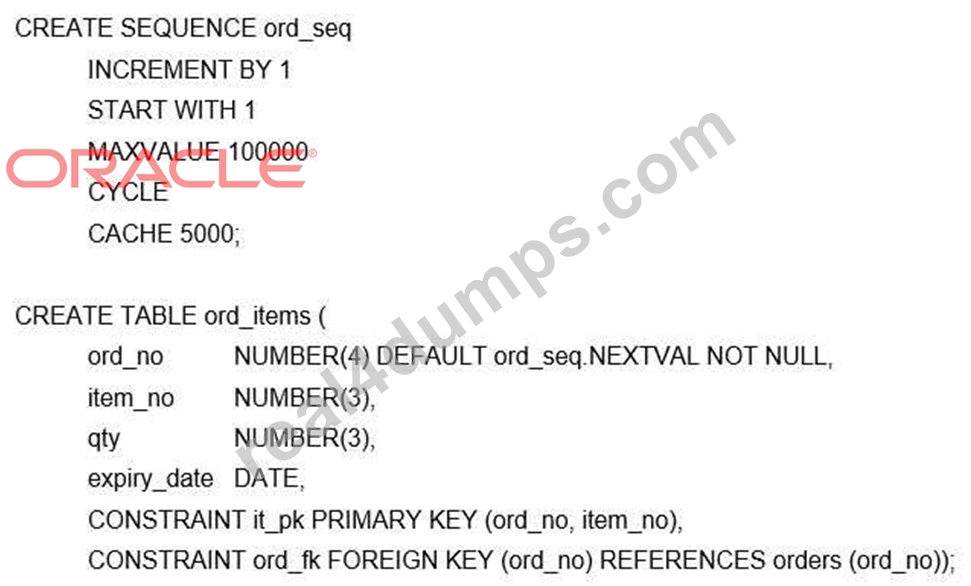
Which two statements are true about the ORD_ITEMS table and the ORD_SEQ sequence? (Choose two.)
- A. Column ORD_NO gets the next number from sequence ORD_SEQ whenever a row is inserted into ORD_ITEMS and no explicit value is given for ORD_NO
- B. Sequence ORD_SEQ cycles back to 1 after every 5000 numbers and can cycle 20 times
- C. If sequence ORD_SEQ is dropped then the default value for column ORD_NO will be NULL for rows inserted into ORD_ITEMS
- D. Any user inserting rows into table ORD_ITEMS must have been granted access to sequence ORD_SEQ
- E. Sequence ORD_SEQ is guaranteed not to generate duplicate numbers
Answer: D,E
NEW QUESTION 25
Which three statements are true about advanced connection options supported by Oracle Net for connection to Oracle Database instances? (Choose three.)
- A. Connect Time Failover requires the use of Transparent Application Failover (TAF)
- B. Source Routing enables the use of Connection Manager (CMAN) which enables network traffic to be routed through a firewall
- C. Connect Time Failover requires the connect string to have two or more listener addresses configured
- D. Load Balancing requires the use of a name server
- E. Source Routing requires the use of a name server
- F. Load Balancing can balance the number of connections to dispatchers when using a Shared Server configuration
Answer: B,C,E
NEW QUESTION 26
Which four statements are true regarding primary and foreign key constraints and the effect they can have on table data? (Choose four.)
- A. Primary key and foreign key constraints can be defined at both the column and table level
- B. A table can have only one primary key but multiple foreign keys
- C. The foreign key columns and parent table primary key columns must have the same names
- D. A table can have only one primary key and foreign key
- E. It is possible for child rows that have a foreign key to remain in the child table at the time the parent row is deleted
- F. Only the primary key can be defined at the column and table level
- G. It is possible for child rows that have a foreign key to be deleted automatically from the child table at the time the parent row is deleted
Answer: A,B,C,G
NEW QUESTION 27
View the Exhibit and examine the structure of the PRODUCTS table.
Which two tasks require subqueries? (Choose two.)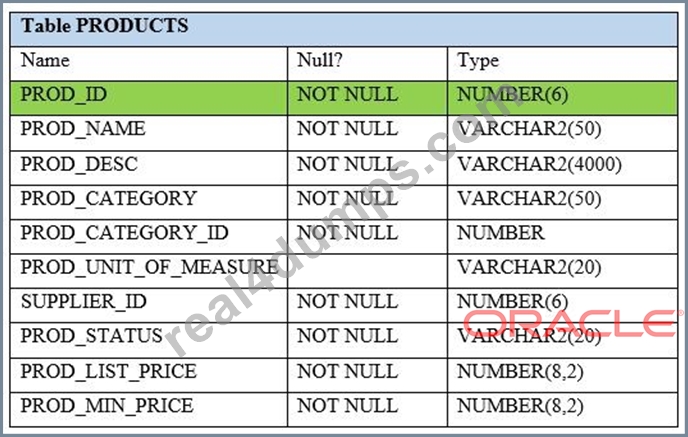
- A. Display the number of products whose PROD_LIST_PRICE is more than the average PROD_LIST_PRICE
- B. Display the total number of products supplied by supplier 102 which have a product status of obsolete
- C. Display the minimum PROD_LIST_PRICE for each product status
- D. Display products whose PROD_MIN_PRICE is more than the average PROD_LIST_PRICE of all products, and whose status is orderable
- E. Display suppliers whose PROD_LIST_PRICE is less than 1000
Answer: A,D
NEW QUESTION 28
Which three statements are true about table data storage in an Oracle Database? (Choose three.)
- A. Data block free space is always contiguous in the middle of the block
- B. Data block headers contain their own Data Block Address (DBA)
- C. Multiple row pieces from the same row may be stored in the same block
- D. Index block free space is always contiguous in the middle of the block
- E. Multiple row pieces from the same row may be stored in different database blocks
- F. A table row piece can be chained across several database blocks
Answer: A,E,F
NEW QUESTION 29
You want to apply the principle of Least Privilege in all your live databases.
One of your requirements is to revoke unnecessary privileges from all users who have them using Privilege Analysis.
Which three types of analyses can be done using the DBMS_PRIVILEGE_CAPTURE package? (Choose three.)
- A. analysis of privileges that a user has on their own schema objects that they did not use
- B. analysis of all privileges used by all users but excluding administrative users in the database
- C. analysis of privileges granted directly to a role that are then used by a user who has been granted that role
- D. analysis of privileges granted indirectly to a role that are then used by a user who has been granted that role
- E. analysis of privileges that a user has on their own schema objects that they did use
- F. analysis of all privileges used by all users including administrative users in the database
Answer: B,C,D
Explanation:
https://docs.oracle.com/en/database/oracle/oracle-database/19/dbseg/performing-privilege-analysis-find-privilege-use.html#GUID-AD683DDB-D345-4702-B1F4-37B79F276B66
NEW QUESTION 30
Examine the description of the SALES1 table:
SALES2 is a table with the same description as SALES1.
Some sales data is duplicated in both tables.
You want to display the rows from the SALES1 table which are not present in the SALES2 table.
Which set operator generates the required output?
- A. INTERSECT
- B. UNION ALL
- C. MINUS
- D. UNION
- E. SUBTRACT
Answer: C
NEW QUESTION 31
A script abc.sql must be executed to perform a job.
A database user HR, who is defined in this database, executes this command:
$ sqlplus hr/hr@orcl @abc.sql
What will happen upon execution?
- A. The command fails because the script must refer to the full path name
- B. The command succeeds and HR will be connected to the orcl and abc.sql databases
- C. The command fails and reports an error because @ is used twice
- D. The command succeeds and HR will be connected to the orcl database instance, and the abc.sql script will be executed
Answer: D
Explanation:
Explanation
NEW QUESTION 32
A database is configured to use automatic undo management with temporary undo enabled.
An UPDATE is executed on a temporary table.
Where is the UNDO stored?
- A. in the temporary tablespace
- B. in the undo tablespace
- C. in the SGA
- D. in the SYSAUX tablespace
- E. in the PGA
Answer: A
Explanation:
http://www.dba-oracle.com/t_temp_undo_enabled.htm
NEW QUESTION 33
Which four account management capabilities can be configured using Oracle profiles? (Choose four.)
- A. the maximum amount of CPU time allowed for a user's sessions before their account is locked
- B. the number of hours for which an account is locked after the configured number of login attempts has been reached
- C. the number of days for which an account is locked after the configured number of login attempts has been reached
- D. the ability to prevent a password from ever being reused
- E. the number of days for which an account may be inactive before it is locked
- F. the number of password changes required within a period of time before a password can be reused
- G. the maximum number of sessions permitted for a user before the account is locked
Answer: B,C,D,F
NEW QUESTION 34
You want to write a query that prompts for two column names and the WHERE condition each time it is executed in a session but only prompts for the table name the first time it is executed.
The variables used in your query are never undefined in your session.
Which query can be used?
- A. SELECT '&&col1', '&&col2'FROM &tableWHERE '&&condition' = '&cond';
- B. SELECT &&col1, &&col2FROM &tableWHERE &&condition;
- C. SELECT &col1, &col2FROM "&table"WHERE &condition;
- D. SELECT &&col1, &&col2FROM &tableWHERE &&condition = &&cond;
- E. SELECT &col1, &col2FROM &&tableWHERE &condition;
Answer: E
NEW QUESTION 35
The INVOICE table has a QTY_SOLD column of data type NUMBER and an INVOICE_DATE column of data type DATE.
NLS_DATE_FORMAT is set to DD-MON-RR.
Which two are true about data type conversions involving these columns in query expressions?
(Choose two.)
- A. invoie_date > '01-02-2019' : uses implicit conversion
- B. invoice_date = '15-march-2019' : uses implicit conversion
- C. CONCAT (qty_sold, invoice_date) : requires explicit conversion
- D. qty_sold BETWEEN `101' AND '110' : uses implicit conversion
- E. qty_sold = `0554982' uses implicit conversion
Answer: B,D
NEW QUESTION 36
Which three activities are recorded in the database alert log? (Choose three.)
- A. block corruption errors
- B. non-default database parameters
- C. session logins and logouts
- D. Data Definition Language (DDL) statements
- E. deadlock errors
Answer: A,B,E
Explanation:
Reference:
https://docs.oracle.com/cd/B28359_01/server.111/b28310/monitoring001.htm#ADMIN11247
NEW QUESTION 37
Examine the description of the CUSTOMERS table: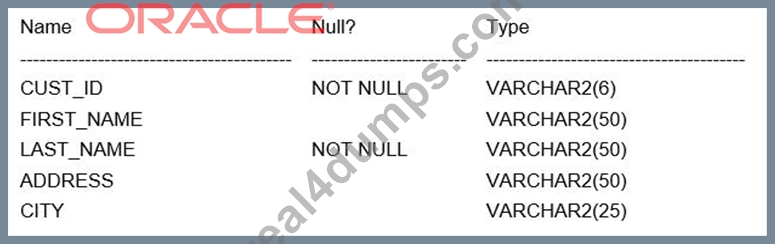
You want to display details of all customers who reside in cities starting with the letter D followed by at least two characters.
Which query can be used?
- A. SELECT * FROM customers WHERE city LIKE `D_%';
- B. SELECT * FROM customers WHERE city = `D_%';
- C. SELECT * FROM customers WHERE city LIKE `D_';
- D. SELECT * FROM customers WHERE city = `%D_';
Answer: A
NEW QUESTION 38
Examine the description of the BOOKS table: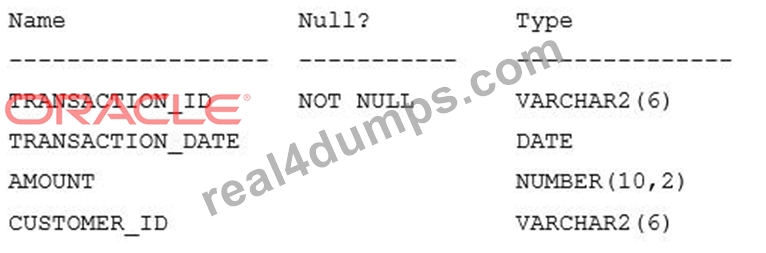
The table has 100 rows.
Examine this sequence of statements issued in a new session:
INSERT INTO books VALUES ('ADV112', 'Adventures of Tom Sawyer', NULL, NULL); SAVEPOINT a; DELETE FROM books; ROLLBACK TO SAVEPOINT a; ROLLBACK; Which two statements are true? (Choose two.)
- A. The first ROLLBACK command restores the 101 rows that were deleted, leaving the inserted row still to be committed
- B. The second ROLLBACK command replays the delete
- C. The second ROLLBACK command undoes the insert
- D. The second ROLLBACK command does nothing
- E. The first ROLLBACK command restores the 101 rows that were deleted and commits the inserted row
Answer: C,E
NEW QUESTION 39
Which three statements are true about single-row functions? (Choose three.)
- A. They can be used only in the WHERE clause of a SELECT statement
- B. They return a single result row per table
- C. The data type returned can be different from the data type of the argument
- D. They can accept only one argument
- E. The argument can be a column name, variable, literal or an expression
- F. They can be nested to any level
Answer: B,C,E
NEW QUESTION 40
......
Latest 100% Passing Guarantee - Brilliant 1Z0-082 Exam Questions PDF: https://www.real4dumps.com/1Z0-082_examcollection.html
Practice Examples and Dumps & Tips for 2022 Latest 1Z0-082 Valid Tests Dumps: https://drive.google.com/open?id=1WenrrSmiqffia7hYnn0B1OGsnOjjOTJZ
