

May-2025 Free CompTIA SK0-005 Exam Question Practice Exams
Ace SK0-005 Certification with 492 Actual Questions
CompTIA SK0-005 exam is an updated version of the SK0-004 exam and includes new content related to emerging technologies such as virtualization, cloud computing, and software-defined networking. SK0-005 exam consists of 90 multiple-choice and performance-based questions and has a duration of 90 minutes. To pass the exam, candidates need to score at least 750 out of 900 points.
CompTIA SK0-005 certification exam is an essential certification for IT professionals who work with server infrastructure. It validates the candidate's skills and knowledge in server administration, making them more valuable to employers. CompTIA Server+ Certification Exam certification is globally recognized and vendor-neutral, making it an ideal certification for IT professionals who work with different types of servers and vendors.
NEW QUESTION # 23
A change in policy requires a complete backup of the accounting server every seven days and a backup of modified data every day. Which of the following would be BEST to restore a full backup as quickly as possible in the event of a complete loss of server data?
- A. A full, weekly backup with daily incremental backups
- B. A full, weekly backup with daily open-file backups
- C. A full, weekly backup with daily differential backups
- D. A full, weekly backup with daily archive backups
Answer: C
Explanation:
Explanation
A differential backup is a type of backup that copies all the files that have changed since the last full backup.
A differential backup requires more storage space than an incremental backup, which only copies the files that have changed since the last backup of any type, but it also requires less time to restore in case of data loss. By combining a full, weekly backup with daily differential backups, the administrator can ensure that only two backup sets are needed to restore a full backup as quickly as possible. Verified References: [Incremental vs Differential Backup]
NEW QUESTION # 24
A technician wants to limit disk usage on a server. Which of the following should the technician implement?
- A. Formatting
- B. Partitioning
- C. Disk quotas
- D. Compression
Answer: C
Explanation:
Reference:https://www.digitalcitizen.life/simple-questions-what-are-disk-quotas-how-set-them-windows/ Explanation: Disk quotas are a way to limit disk usage on a server by setting a maximum amount of space that each user or group can use. Disk quotas can help manage disk space allocation, prevent disk space exhaustion, and enforce fair usage policies. Disk quotas can be set at the volume level or at the folder level, depending on the file system and operating system used.Reference:https://docs.microsoft.com/en-us/windows-server/storage
/ntfs/ntfs-disk-quotas-overview
NEW QUESTION # 25
SIMULATION
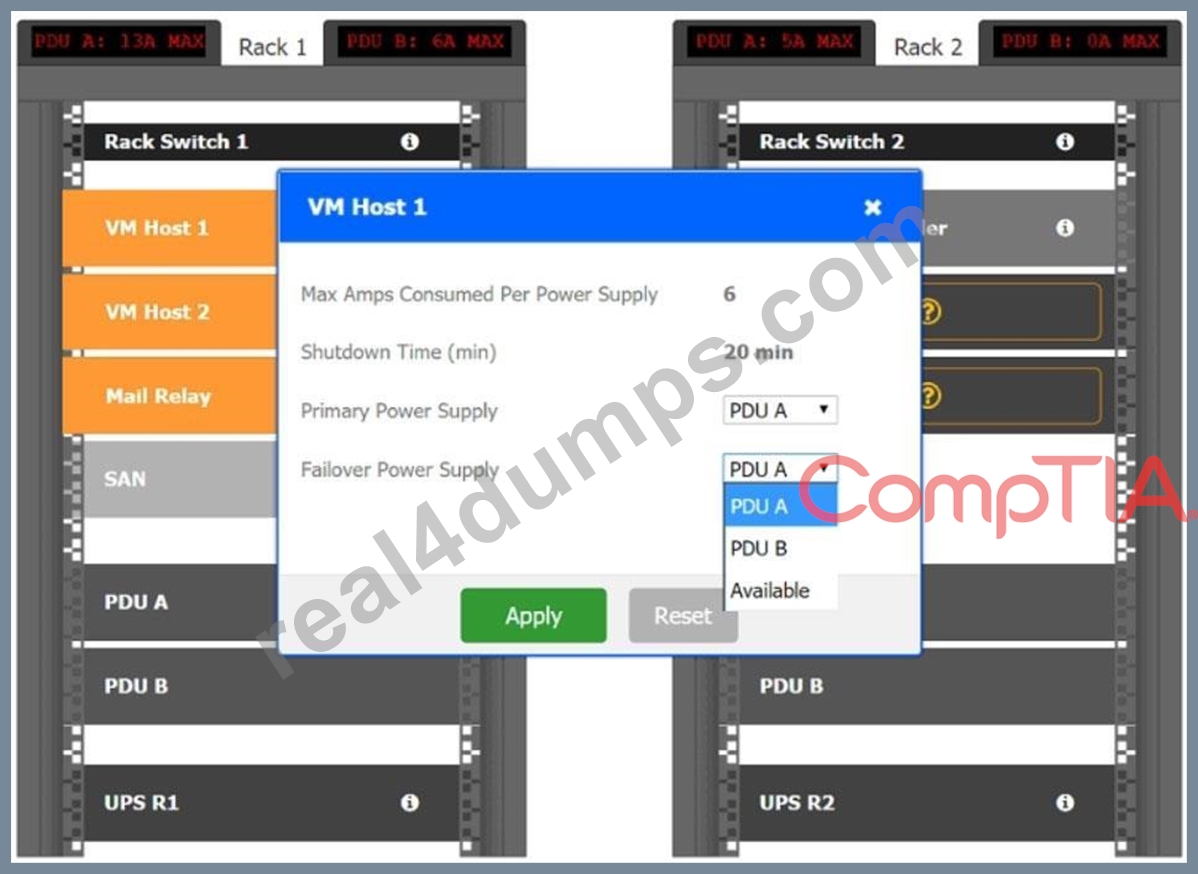
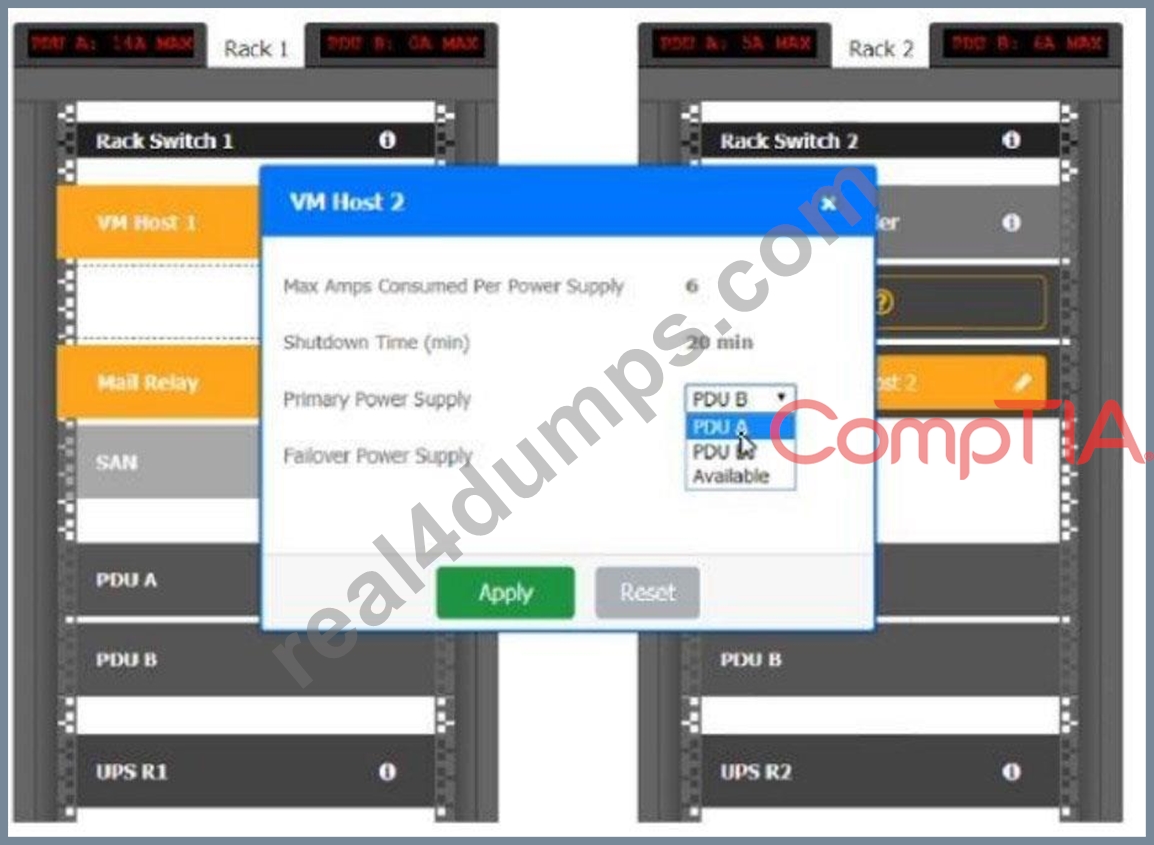
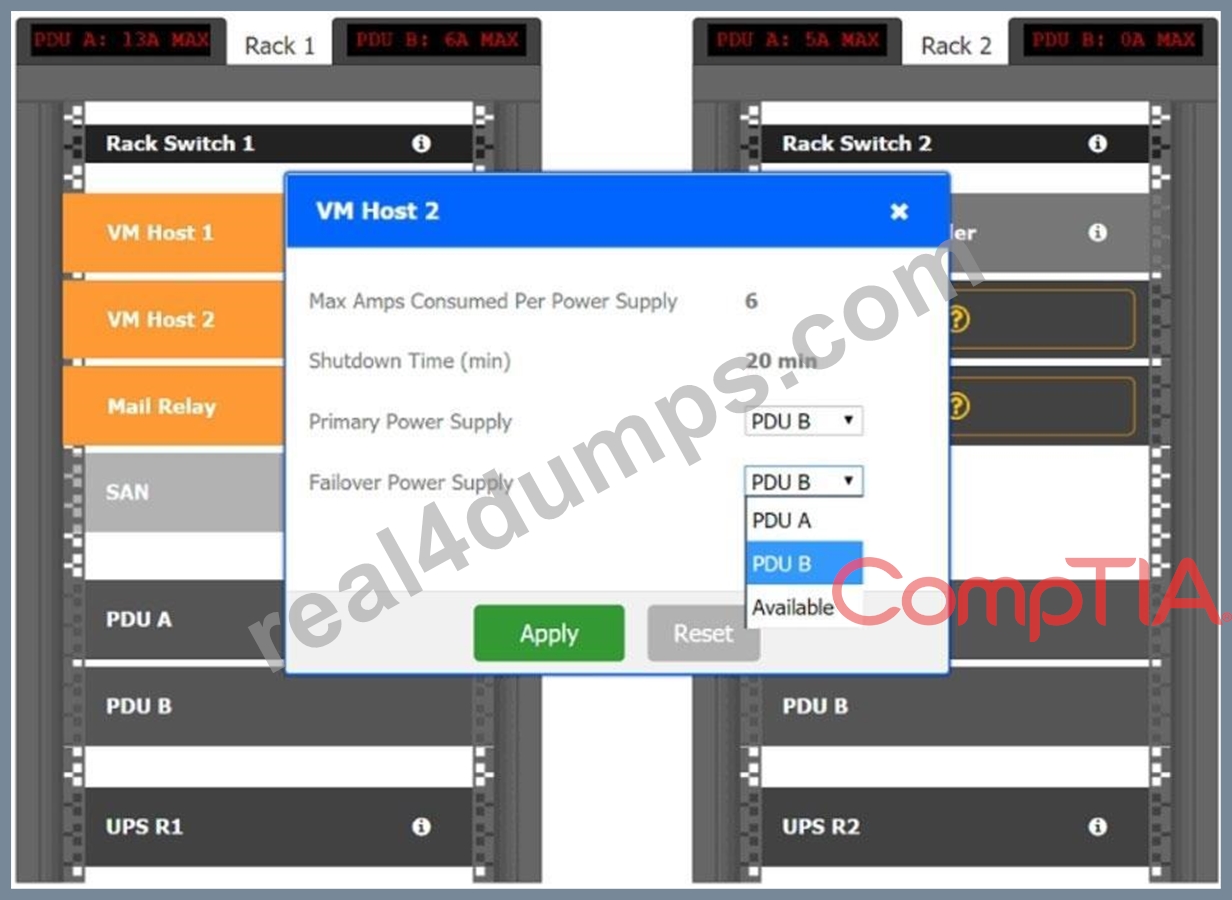
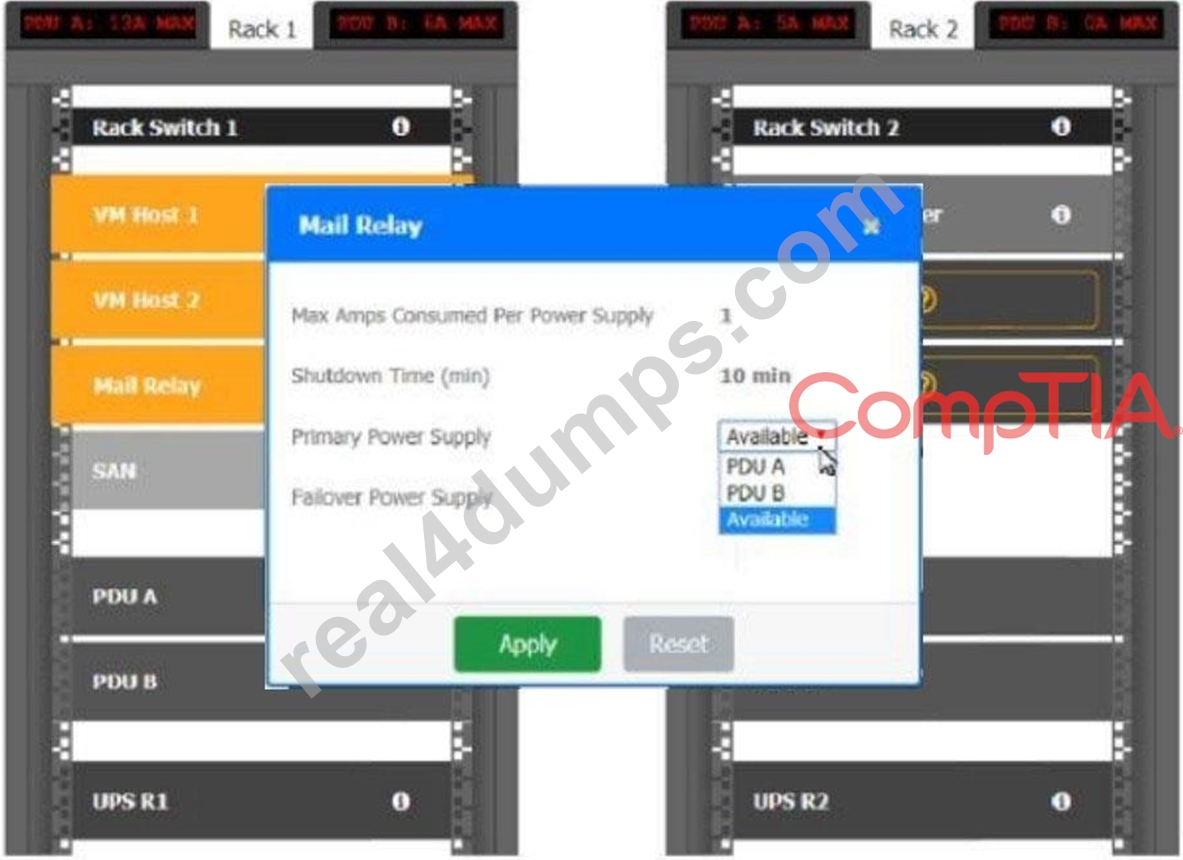
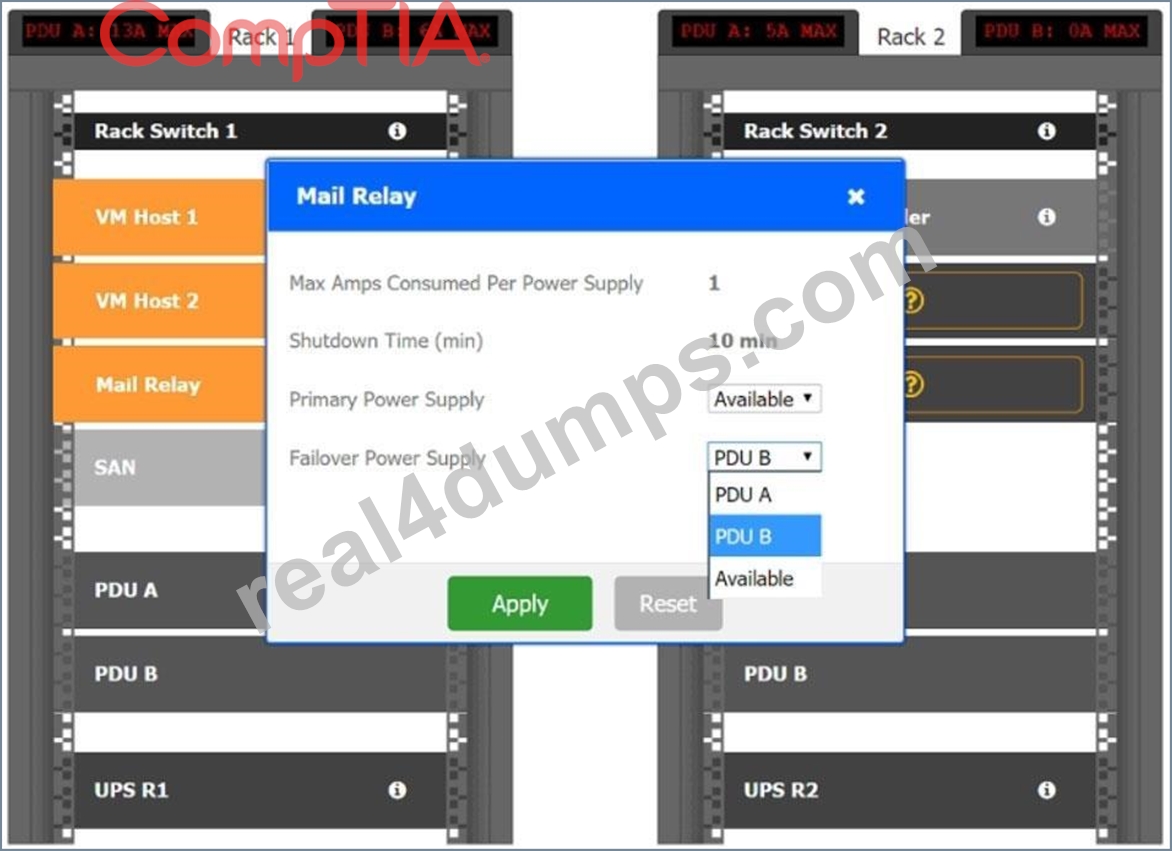
A recent power outage caused email services to go down. A server administrator also received averts from the datacenter's UPS.
After some investigation, the server administrator learned that each PDU was rated at a maximum of 12A.
Instructions
Ensure power redundancy is implemented throughout each rack and UPS alarms are resolved.
Ensure the maximum potential PDU consumption does not exceed
80% (or 9.6A).
a. PDU selections must be changed using the penal icon.
b. VM Hosts 1 and 2 and Mall Relay can be moved between racks.
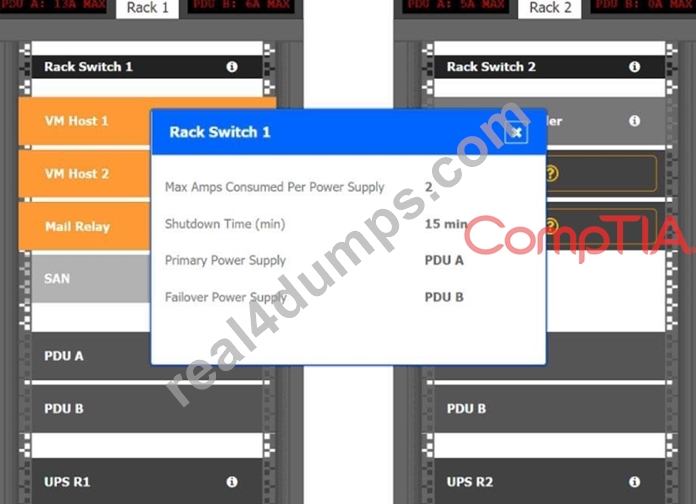
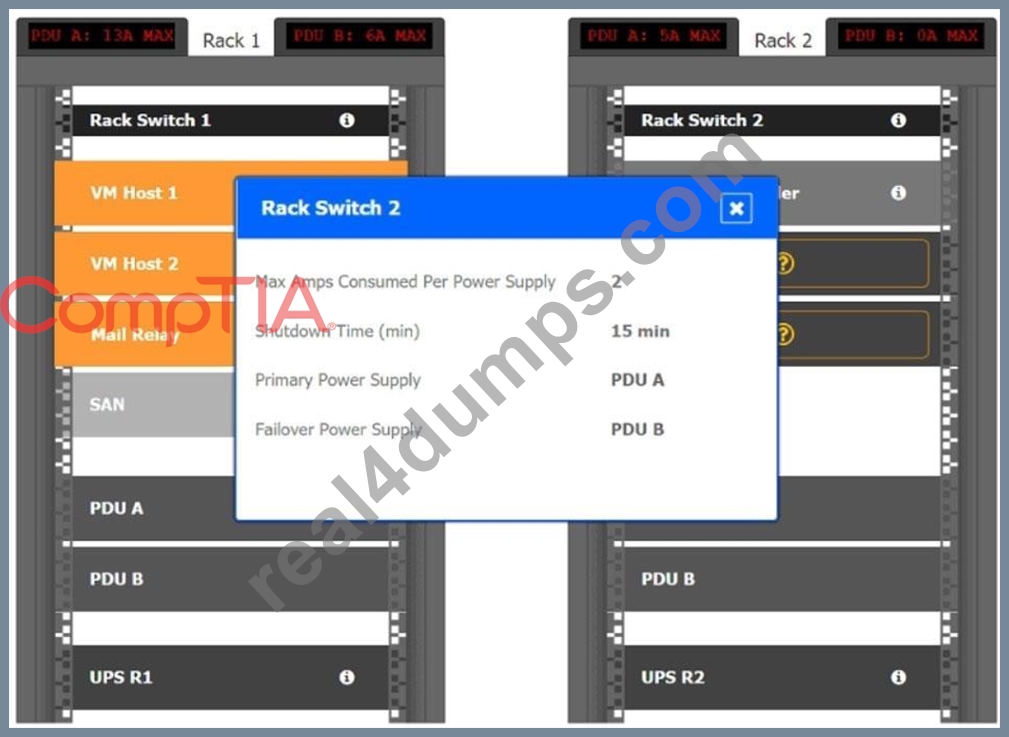
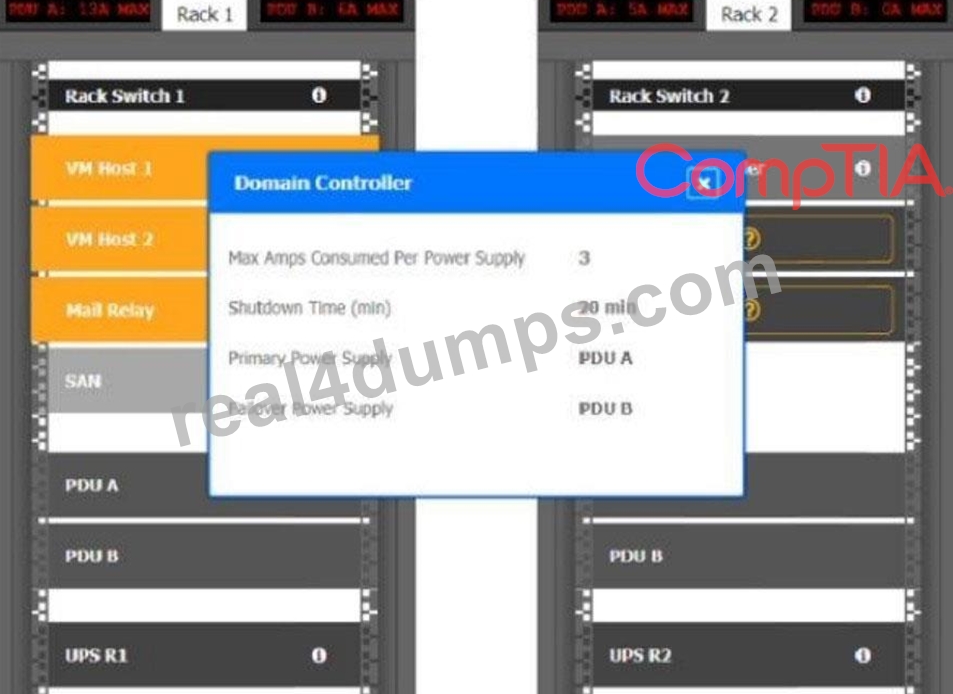
c. Certain devices contain additional details.
If at any time you would like to bring back the initial state of the simulation, please click the Reset All button.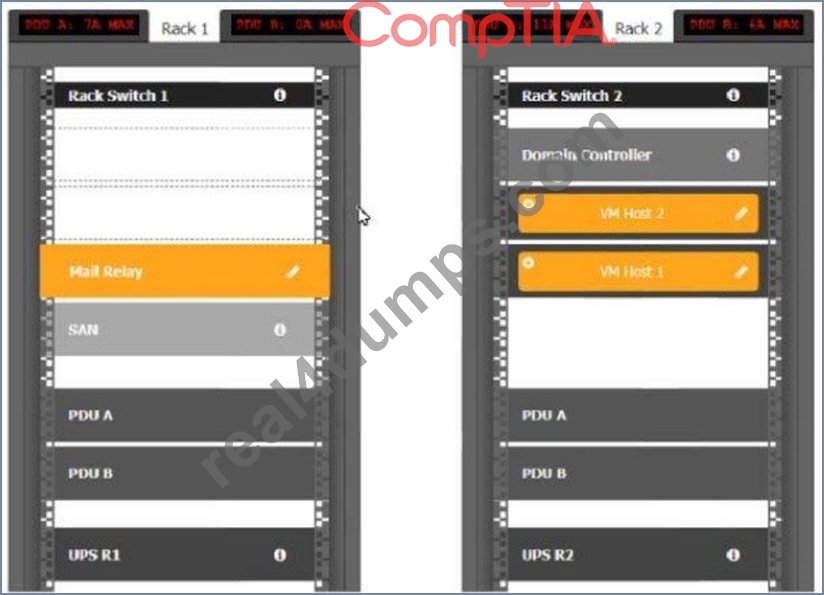
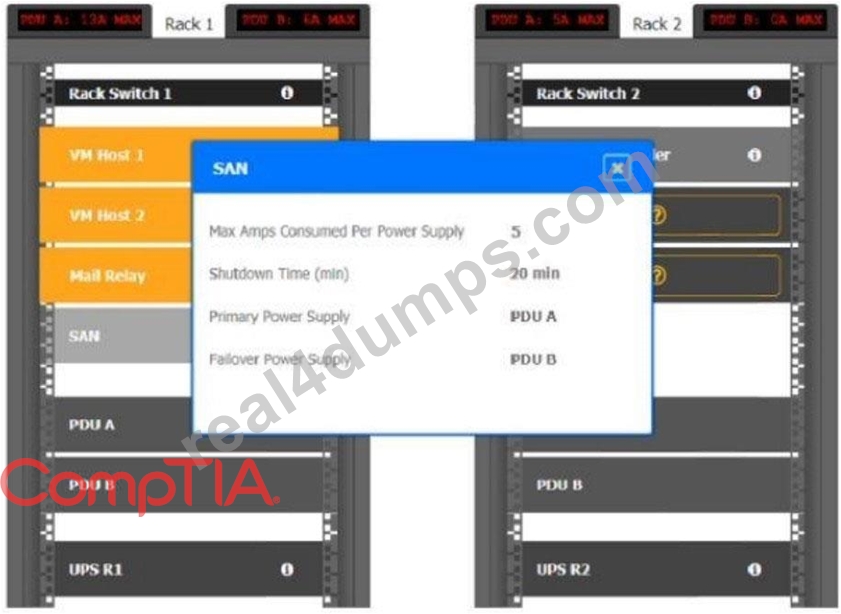
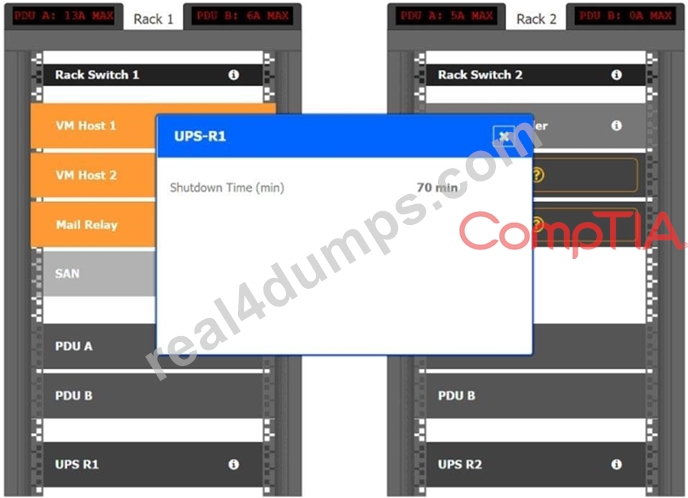
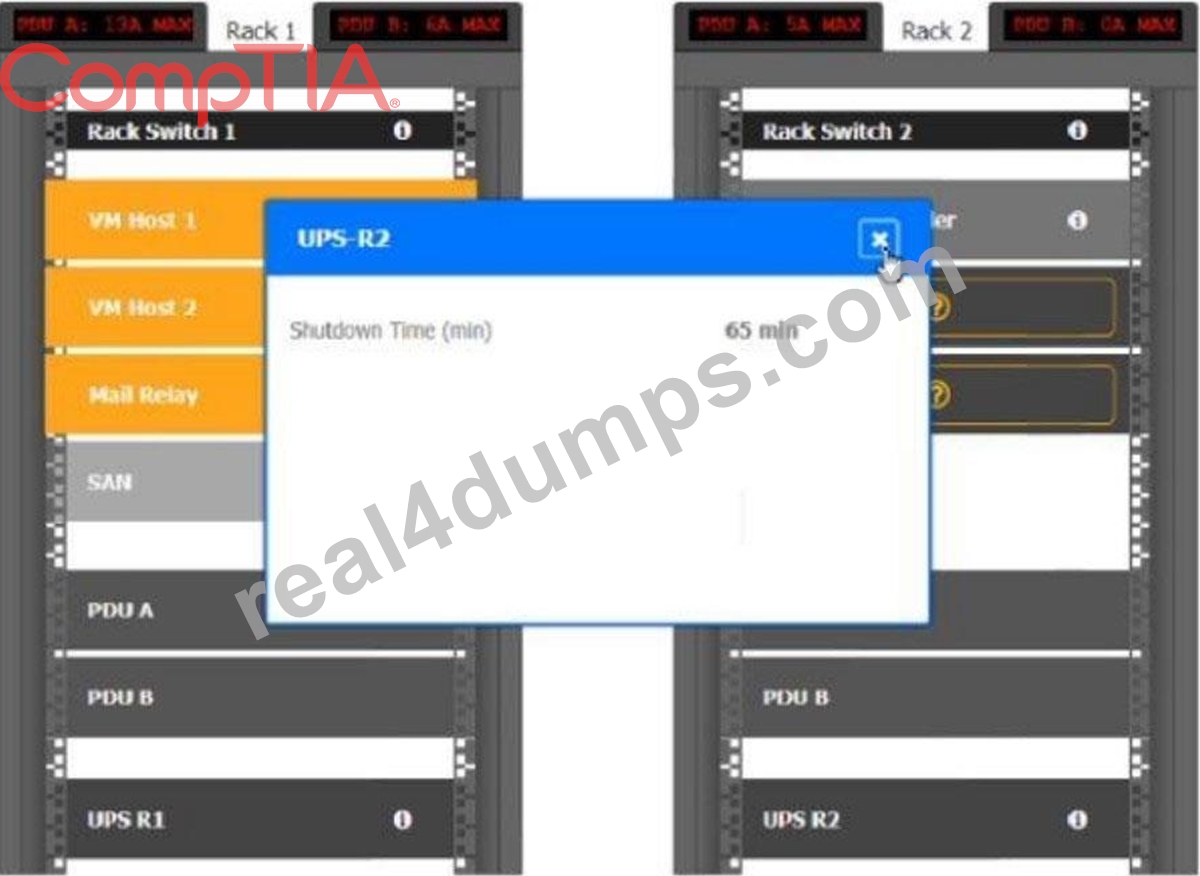
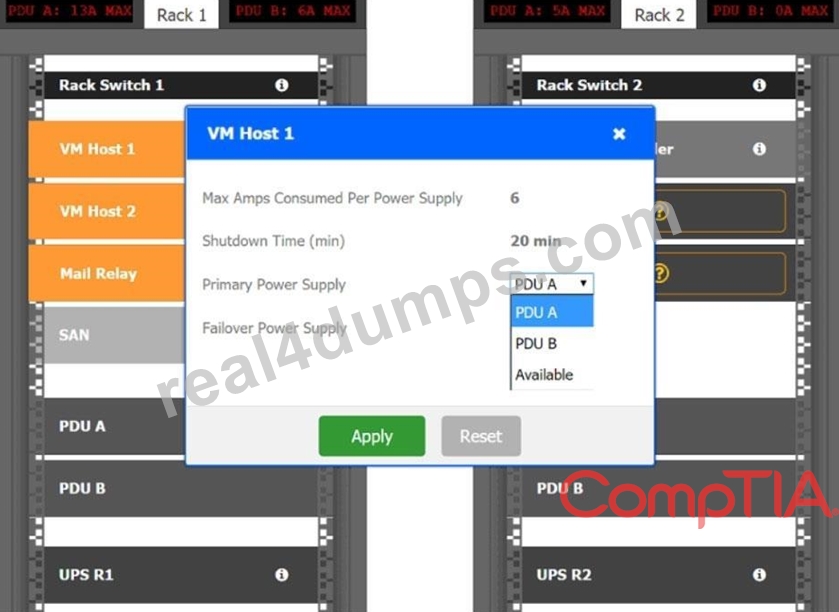
Answer:
Explanation:
1. Mailrelay - Keep the mail relay on the existing Rack1 and change the primary power supply to PDU-B and Failover powersupply as PDU B.
2. Move the VM Host 1 and VM Host2 to Rack2.
Assign primary power supply PDU A to VM host1
Assign Failover power supply PDU B to VM host1
Assign primary power supply PDU B to VM host2
Assign Failover power supply PDU A to VM host2
NEW QUESTION # 26
A technician needs to restore data from a backup. The technician has these files in the backup inventory: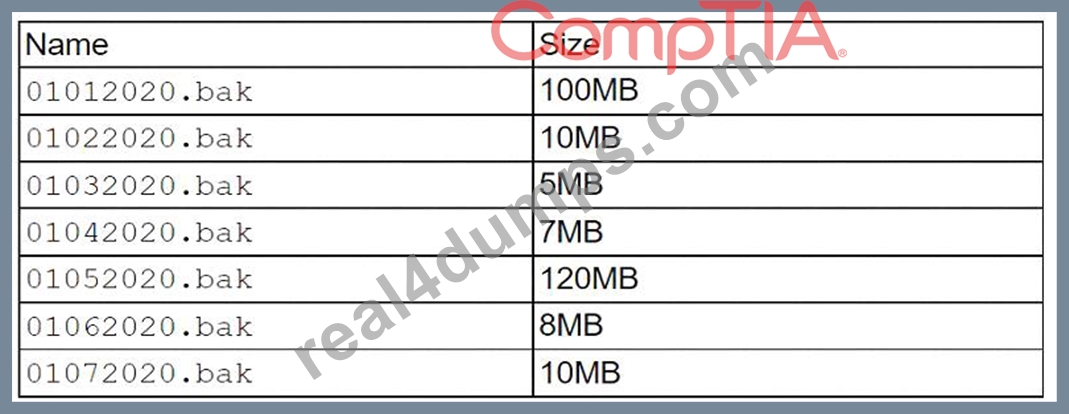
Which of the following backup types is being used if the file 01062020.bak requires another file to restore data?
- A. Full
- B. Snapshot
- C. Incremental
- D. Differential
Answer: C
Explanation:
Explanation
An incremental backup only backs up files that have changed since the last backup, whether it was a full or an incremental backup. Therefore, an incremental backup file may require another file to restore data, depending on the sequence of backups. A full backup backs up all files and does not require any other file to restore data.
A snapshot is a point-in-time copy of data that does not depend on other files. A differential backup backs up files that have changed since the last full backup and does not require any other file to restore data.
NEW QUESTION # 27
A systems administrator recently upgraded the memory in a server, and now the server does not turn on, and nothing is displayed on the screen.
Which of the following is the next step the administrator should take to diagnose the error without opening the machine?
- A. Call technical support.
- B. Listen for POST code beeps.
- C. Check the monitor connection.
- D. Perform a cold reboot.
Answer: B
Explanation:
A power-on self-test (POST) is a diagnostic process that runs when a server is turned on to check the basic functionality of the hardware components and report any errors or faults. A POST code is a series of beeps or flashes that indicate the status of the POST process and identify any problems that prevent the server from booting up. A POST code can be heard through a speaker or seen on a display attached to the server motherboard. A POST code is useful for diagnosing errors without opening the machine or using any software tools.
References: CompTIA Server+ SK0-005 Certification Study Guide, Chapter 5, Lesson 5.1, Objective 5.1
NEW QUESTION # 28
Which of me following is the BEST action to perform before applying patches to one of the hosts in a high availability cluster?
- A. Fallback cluster services.
- B. Disable the heartbeat network.
- C. Failover all VMs.
- D. Set the cluster to active-active.
Answer: C
Explanation:
Explanation
This is the best action to perform before applying patches to one of the hosts in a high availability cluster. A high availability cluster is a group of hosts that act like a single system and provide continuous uptime. A high availability cluster is often used for load balancing, backup, and failover purposes. Failover is a process of transferring workloads from one host to another in case of a failure or maintenance. By failing over all VMs (Virtual Machines) from the host that needs to be patched to another host in the cluster, the technician can ensure that there is no downtime or data loss during the patching process. Disabling the heartbeat network is not a good action to perform, as this would disrupt the communication and synchronization between the hosts in the cluster. Fallback cluster services is not a valid term, but it may refer to restoring cluster services after a failover, which is not relevant before applying patches. Setting the cluster to active-active is not a good action to perform, as this would increase the load on both hosts and reduce redundancy. References:
https://www.howtogeek.com/190014/virtualization-basics-understanding-techniques-and-fundamentals/
https://www.howtogeek.com/428483/what-is-end-to-end-encryption-and-why-does-it-matter/
NEW QUESTION # 29
An administrator reviews a new server that was received from a vendor and notes the OS has been installed to a two-drive array configured with RAID 0. Which of the following best describes what will happen if a drive in that array fails?
- A. The server will gracefully shut down.
- B. The server will continue to operate normally.
- C. The server will operate but in read-only mode.
- D. The server will immediately crash.
Answer: D
Explanation:
RAID 0 is a configuration that splits data evenly across two or more disks without parity or mirroring. This improves performance but offers no fault tolerance. If a drive in a RAID 0 array fails, the data on the array becomes inaccessible and the server will immediately crash. The other options are not applicable to RAID 0. References: [CompTIA Server+ Certification Exam Objectives], Domain 3.0: Storage, Objective 3.2: Given a scenario, configure RAID using best practices.
NEW QUESTION # 30
A technician is laying out a filesystem on a new Linux server. Which of the following tools would work BEST to allow the technician to increase a partition's size in the future without reformatting it?
- A. fdisk
- B. DiskPart
- C. Format
- D. LVM
Answer: D
NEW QUESTION # 31
A server administrator receives the following output when trying to ping a local host:
Which of the following is MOST likely the issue?
- A. VLAN
- B. DHCP
- C. DNS
- D. Firewall
Answer: D
Explanation:
A firewall is a network device or software that filters and controls the incoming and outgoing traffic based on predefined rules. A firewall can block or allow certain types of packets, ports, protocols, or IP addresses. The output of the ping command shows that the local host is unreachable, which means that there is no network connectivity between the source and the destination. This could be caused by a firewall that is blocking the ICMP (Internet Control Message Protocol) packets that ping uses to test the connectivity. References: https://www.comptia.org/training/resources/exam-objectives/comptia-server-sk0-005-exam-objectives (Objective 2.2)
NEW QUESTION # 32
An administrator is investigating a physical server that will not boot into the OS. The server has three hard drives configured in a RAID 5 array. The server passes POST, but the OS does not load. The administrator verifies the CPU and RAM are both seated correctly and checks the dual power supplies. The administrator then verifies all the BIOS settings are correct and connects a bootable USB drive in the server, and the OS loads correctly. Which of the following is causing the issue?
- A. The page file is too small.
- B. There are multiple failed hard drives.
- C. RAID 5 requires four drives
- D. There are mismatched RAM modules.
- E. The CPU has failed.
Answer: B
NEW QUESTION # 33
A server administrator just installed a new physical server and needs to harden the applications on the server.
Which of the following best describes a method of application hardening?
- A. Enable a BIOS password.
- B. Disable unneeded hardware.
- C. Set the boot order.
- D. Install the latest patches.
Answer: D
Explanation:
A method of application hardening is installing the latest patches. Application hardening is a process of reducing the attack surface and vulnerabilities of an application by applying security measures and best practices. Installing the latest patches is one way to harden an application, as patches are updates that fix bugs, errors, or security issues in an application. By installing the latest patches, an application can be protected from known exploits or threats.
References: CompTIA Server+ SK0-005 Certification Study Guide, Chapter 3, Lesson 3.5, Objective 3.5
NEW QUESTION # 34
A user is unable to modify files on a Windows fileshare. A technician examines the system and determines the user is a member of Group A. Group A was granted full control over the files.
Which of the following is MOST likely causing the access issues?
- A. Share permissions
- B. SIEM policies
- C. Firewall ports
- D. IDS rules
Answer: A
NEW QUESTION # 35
Ann, an administrator, is configuring a two-node cluster that will be deployed. To check the cluster's functionality, she shuts down the active node. Cluster behavior is as expected, and the passive node is now active. Ann powers on the server again and wants to return to the original configuration. Which of the following cluster features will allow Ann to complete this task?
- A. Redundancy
- B. Failback
- C. Heartbeat
- D. Load balancing
Answer: B
Explanation:
When you research server clustering, you frequently hear the terms failover and failback. Failover refers to the failure of the active service provider node and passive node's taking over of its responsibilities. At that point, the server that was the passive node becomes the active node. It services clients and handles the cluster's duties. Once the original active node returns to service, you may set it to act as the new passive node, or you may shift the services back to it, causing it to take back its active node role and relegating the formerly passive server to its original role. The term failback refers to the service returning to the original active node.
NEW QUESTION # 36
Joe. a user m the IT department cannot save changes to a sensitive file on a Linux server. An 1s -1& snows the following listing;
Which of the following commands would BEST enable the server technician to allow Joe tohaveaccess without granting excessive access to others?
- A. chown Joe filename
- B. Chmod g+w filename
- C. chmod 777 filename
- D. chgrp IT filename
Answer: B
Explanation:
Explanation
The chmod command is used to change the permissions of files and directories. The g+w option means to grant write permission to the group owner of the file. Since Joe is a member of the IT group, which is also the group owner of the file, this command will allow him to save changes to the file without affecting the permissions of other users. Verified References: [Linux chmod command]
NEW QUESTION # 37
The Chief Information Officer (CIO) of a datacenter is concerned that transmissions from the building can be detected from the outside. Which of the following would resolve this concern? (Choose two.)
- A. Bollards
- B. Signal blocking
- C. RFID
- D. Reflective glass
- E. Camouflage
- F. Proximity readers
Answer: B,D
Explanation:
Explanation
The best solutions to resolve the concern of transmissions from the building being detected from outside are signal blocking and reflective glass. Signal blocking is a method of preventing or interfering with electromagnetic signals from escaping or entering a certain area. Signal blocking can be achieved by using various materials or devices that create physical barriers or generate noise or jamming signals. Signal blocking can protect data transmissions from being intercepted or eavesdropped by unauthorized parties. Reflective glass is a type of glass that has a coating or film that reflects light and heat. Reflective glass can reduce glare and solar radiation, as well as prevent visual observation from outside. Reflective glass can enhance privacy and security for datacenter operations.
NEW QUESTION # 38
A technician is setting up a repurposed server. The minimum requirements are 2TB while ensuring the highest performance and providing support for one drive failure. The technician has the following six drives available:
Which of the following drive selections should the technician utilize to best accomplish this goal?
- A. 1, 2, 3, 4, and 6
- B. 1, 2, 3, 5, and 6
- C. 1, 2, 4, 5, and 6
- D. 1,2, 4, and 6
Answer: C
Explanation:
* RAID 5 configuration: Using five of the available drives in a RAID 5 configuration meets the requirements for:
* Storage capacity: Four 600GB drives (2, 5, and 6) provide a total usable capacity of 2.4TB (4 *
600 * 0.8), exceeding the minimum requirement of 2TB. RAID 5 introduces parity data for fault tolerance, sacrificing some usable space (one drive's worth).
* Performance: The combination of multiple drives in a RAID 5 array improves read performance compared to a single drive setup.
* Fault tolerance: Even with a single drive failure (any of the five drives used in the RAID 5), the remaining drives can reconstruct the lost data, allowing the server to continue operating.
NEW QUESTION # 39
Which of the following documents would be useful when trying to restore IT infrastructure operations after a non-planned interruption?
- A. Business impact analysis
- B. Service-level agreement
- C. Disaster recovery plan
- D. Business continuity plan
Answer: C
NEW QUESTION # 40
Which of the following technologies would allow an administrator to build a software RAID on a Windows server?
- A. GPT
- B. Logical volume management
- C. Dynamic disk
- D. UEFI
Answer: C
Explanation:
Dynamic disk is a technology that allows an administrator to build a software RAID on a Windows server.
Dynamic disk is a type of disk management that supports creating volumes that span multiple disks, stripe data across disks, mirror data between disks, or use parity for fault tolerance. Dynamic disk can be used to create RAID 0 (striping), RAID 1 (mirroring), RAID 5 (striping with parity), or spanned volumes on Windows servers. Logical volume management is a technology that allows creating and resizing logical volumes on Linux servers. GPT (GUID Partition Table) is a standard for defining the partition structure on a disk. UEFI (Unified Extensible Firmware Interface) is a specification for the interface between the operating system and the firmware. References: https://www.howtogeek.com/school/using-windows-admin-tools-like-a- pro/lesson2/ https://www.howtogeek.com/howto/40702/how-to-manage-and-use-lvm-logical-volume- management-in-ubuntu/ https://www.howtogeek.com/193669/whats-the-difference-between-gpt-and-mbr- when-partitioning-a-drive/ https://www.howtogeek.com/56958/htg-explains-how-uefi-will-replace-the-bios/
NEW QUESTION # 41
......
SK0-005 Questions PDF [2025] Use Valid New dump to Clear Exam: https://www.real4dumps.com/SK0-005_examcollection.html
PASS CompTIA SK0-005 EXAM WITH UPDATED DUMPS: https://drive.google.com/open?id=1iJxk4C5wpXWkyTUGDqRy5_DQ9rMznalG
